mirror of
https://github.com/NohamR/knowledge-kit.git
synced 2026-05-25 12:27:15 +00:00

2432 lines
77 KiB
Markdown
2432 lines
77 KiB
Markdown
# Runtime
|
||
|
||
> 做很多需求或者是技术细节验证的时候会用到 Runtime 技术,用了挺久的了,本文就写一些场景和源码分析相关的文章。
|
||
|
||
## isa 本质
|
||
|
||
在 arm64 架构之前,isa 就是一个普通的指针,存储着 Class或Meta-Class 对象的内存地址。
|
||
|
||
在 arm64 之后,对 isa 进行了优化,变成了一个共用体(union)结构,还使用位域来存储更多的信息。
|
||
|
||
```c
|
||
union isa_t
|
||
{
|
||
Class cls;
|
||
uintptr_t bits;
|
||
# if __arm64__
|
||
# define ISA_MASK 0x0000000ffffffff8ULL
|
||
# define ISA_MAGIC_MASK 0x000003f000000001ULL
|
||
# define ISA_MAGIC_VALUE 0x000001a000000001ULL
|
||
struct {
|
||
uintptr_t nonpointer : 1;
|
||
uintptr_t has_assoc : 1;
|
||
uintptr_t has_cxx_dtor : 1;
|
||
uintptr_t shiftcls : 33; // MACH_VM_MAX_ADDRESS 0x1000000000
|
||
uintptr_t magic : 6;
|
||
uintptr_t weakly_referenced : 1;
|
||
uintptr_t deallocating : 1;
|
||
uintptr_t has_sidetable_rc : 1;
|
||
uintptr_t extra_rc : 19;
|
||
# define RC_ONE (1ULL<<45)
|
||
# define RC_HALF (1ULL<<18)
|
||
};
|
||
};
|
||
```
|
||
|
||
struct 内部的成员变量可以指定占用内存位数, `uintptr_t nonpointer : 1` 代表占用1个字节
|
||
|
||
其中,结构体里面的属于”位域“
|
||
|
||
- nonpointer:0,代表普通的指针,存储着Class、Meta-Class对象的内存地址;1,代表优化过,使用位域存储更多的信息
|
||
|
||
- has_assoc:是否有设置过关联对象,如果没有,释放时会更快
|
||
|
||
- has_cxx_dtor:是否有C++的析构函数(.cxx_destruct),如果没有,释放时会更快
|
||
|
||
- shiftcls:存储着Class、Meta-Class对象的内存地址信息
|
||
|
||
- magic:用于在调试时分辨对象是否未完成初始化
|
||
|
||
- weakly_referenced:是否有被弱引用指向过,如果没有,释放时会更快
|
||
|
||
- deallocating:对象是否正在释放
|
||
|
||
- extra_rc:里面存储的值是引用计数器减1(刚创建出的对象,查看这个信息位0,因为存储着-1之后的引用计数)
|
||
|
||
- has_sidetable_rc:引用计数器是否过大无法存储在isa中;如果为1,那么引用计数会存储在一个叫SideTable的类的属性中
|
||
|
||
上面说的更快,是如何得出结论的?
|
||
|
||
查看 objc4 源代码看到对象执行销毁函数的时候会判断对象是否有关联对象、析构函数,有的话分别调用析构函数、移除关联对象等逻辑。
|
||
|
||
```c
|
||
/***********************************************************************
|
||
* objc_destructInstance
|
||
* Destroys an instance without freeing memory.
|
||
* Calls C++ destructors.
|
||
* Calls ARC ivar cleanup.
|
||
* Removes associative references.
|
||
* Returns `obj`. Does nothing if `obj` is nil.
|
||
**********************************************************************/
|
||
void *objc_destructInstance(id obj)
|
||
{
|
||
if (obj) {
|
||
// Read all of the flags at once for performance.
|
||
bool cxx = obj->hasCxxDtor();
|
||
bool assoc = obj->hasAssociatedObjects();
|
||
|
||
// This order is important.
|
||
if (cxx) object_cxxDestruct(obj);
|
||
if (assoc) _object_remove_assocations(obj);
|
||
obj->clearDeallocating();
|
||
}
|
||
|
||
return obj;
|
||
}
|
||
```
|
||
|
||
isa 在 arm64 之后必须通过 `ISA_MASK` 去查询 class(类对象、元类对象) 真正的地址
|
||
|
||
`0x0000000ffffffff8ULL` 用程序员模式打开计算器
|
||
|
||

|
||
|
||
其中,结构体中的数据存放大体是下面的结构:
|
||
|
||
extra_rc、has_sidetable_rc、deallocating、weakly_referenced、magic、shiftcls、has_has_cxx_dtor、assoc、nonpointer
|
||
|
||
知道结构体可以指定存储大小这个功能后,可以看到 isa_t 联合体与 ISA_MASK 按位与之后的地址,其实就是类真实的地址信息(可能是类对象、也有可能是元类对象)
|
||
|
||
如果要找出下面中间的 `1010` 如何实现?按位与即可,且要找的位置补充位1,其他位置为0
|
||
|
||
```shell
|
||
0b0010 1000
|
||
|
||
0b0011 1100
|
||
-----------
|
||
0b0010 1000
|
||
```
|
||
|
||
结论:**根据按位与的效果。`ISA_MASK` 的后3位都是0,所以我们找到的类地址二进制表示时后3位一定为0**
|
||
|
||
我们可以验证下
|
||
|
||
```objectivec
|
||
Person *p = [[Person alloc] init];
|
||
NSLog(@"%p", [p class]); // 0x1000081d8
|
||
NSLog(@"%p", object_getClass([Person class])); // 0x100008200
|
||
NSLog(@"%p", object_getClass([NSObject class])); // 0x7ff84cb29fe0
|
||
NSLog(@"%p", object_getClass([NSString class])); // 0x7ff84c9dcc28
|
||
```
|
||
|
||
为什么有的结尾是8?
|
||
|
||
16进制的8转为二进制,`0x1000`
|
||
|
||
关于这部分的调试,需要在真机上运行,真机上 arm64,拷贝对象地址到系统自带的运算器(程序员模式),查看64位地址。按照下面的顺序一一查看
|
||
|
||
`extra_rc、has_sidetable_rc、deallocating、weakly_referenced、magic、shiftcls、has_has_cxx_dtor、assoc、nonpointer`
|
||
|
||
所以可以根据 isa 信息查看对象是否创建过关联对象、有没有设置弱引用、
|
||
|
||
## 模仿系统位运算设计 API
|
||
|
||
系统很多 API 都有位或运算。比如 KVO 中的 options,可以传递 `NSKeyValueObservingOptionNew | NSKeyValueObservingOptionOld` ,那么系统是如何知道我到底传递了哪几个值?
|
||
|
||
按位或运算
|
||
|
||
```shell
|
||
0b0000 0001 // 1
|
||
0b0000 0010 // 2
|
||
0b0000 0100 // 4
|
||
------------
|
||
0b0000 0111 // 7
|
||
```
|
||
|
||
可以看到上面3个数,按位或之后的结果为 `0b0000 0111`
|
||
|
||
按位与运算。
|
||
|
||
```shell
|
||
0b0000 0111
|
||
0b0000 0001
|
||
-----------
|
||
0b0000 0001
|
||
|
||
0b0000 0111
|
||
0b0000 0010
|
||
-----------
|
||
0b0000 0010
|
||
|
||
0b0000 0111
|
||
0b0000 0100
|
||
-----------
|
||
0b0000 0100
|
||
|
||
0b0000 0111
|
||
0b0000 1000
|
||
-----------
|
||
0b0000 0000
|
||
```
|
||
|
||
我们发现上面3个数按位或之后的数字,分别与每个数按位与,得到的结果就是数据本身。
|
||
|
||
与一个不是3个数之一的数按位与,得到的结果为`0b0000 0000`。利用这个特性我们可以判断传递来的参数是不是包含了某个值
|
||
|
||
```objectivec
|
||
typedef enum {
|
||
OptionsEast = 1<<0, // 0b0001
|
||
OptionsSouth = 1<<1, // 0b0010
|
||
OptionsWest = 1<<2, // 0b0100
|
||
OptionsNorth = 1<<3 // 0b1000
|
||
} Options;
|
||
|
||
- (void)setOptions:(Options)options
|
||
{
|
||
if (options & OptionsEast) {
|
||
NSLog(@"我自东边来");
|
||
}
|
||
|
||
if (options & OptionsSouth) {
|
||
NSLog(@"我自南边来");
|
||
}
|
||
|
||
if (options & OptionsWest) {
|
||
NSLog(@"我自西边来");
|
||
}
|
||
|
||
if (options & OptionsNorth) {
|
||
NSLog(@"我自北边来");
|
||
}
|
||
}
|
||
[self setOptions: OptionsWest | OptionsNorth];
|
||
// 我自西边来
|
||
// 我自北边来
|
||
```
|
||
|
||
## 类对象 Class 的结构
|
||
|
||
查看 objc4 源代码看看
|
||
|
||
```c
|
||
struct objc_object {
|
||
private:
|
||
isa_t isa;
|
||
}
|
||
|
||
struct objc_class : objc_object {
|
||
// Class ISA;
|
||
Class superclass;
|
||
cache_t cache; // formerly cache pointer and vtable
|
||
class_data_bits_t bits; // class_rw_t * plus custom rr/alloc flags
|
||
};
|
||
```
|
||
|
||
结构体继承于 `objc_object` 等同于下面代码
|
||
|
||
```c
|
||
struct objc_class : objc_object {
|
||
isa_t isa;
|
||
Class superclass;
|
||
cache_t cache; // 方法缓存
|
||
class_data_bits_t bits; // 用于获取具体的类信息
|
||
};
|
||
```
|
||
|
||
```c
|
||
struct class_rw_t {
|
||
// Be warned that Symbolication knows the layout of this structure.
|
||
uint32_t flags;
|
||
uint32_t version;
|
||
|
||
const class_ro_t *ro;
|
||
|
||
method_array_t methods; // 方法列表
|
||
property_array_t properties; // 属性列表
|
||
protocol_array_t protocols; // 协议列表
|
||
|
||
Class firstSubclass;
|
||
Class nextSiblingClass;
|
||
|
||
char *demangledName;
|
||
};
|
||
|
||
struct class_data_bits_t {
|
||
// Values are the FAST_ flags above.
|
||
uintptr_t bits;
|
||
public:
|
||
|
||
class_rw_t* data() {
|
||
return (class_rw_t *)(bits & FAST_DATA_MASK);
|
||
}
|
||
}
|
||
```
|
||
|
||
可以看到 `objc_class` 获取 bits 里的真实数据需要经过按位与 `FAST_DATA_MASK`
|
||
|
||
```c
|
||
struct class_ro_t {
|
||
uint32_t flags;
|
||
uint32_t instanceStart;
|
||
uint32_t instanceSize; // instance 对象占用的内存空间
|
||
#ifdef __LP64__
|
||
uint32_t reserved;
|
||
#endif
|
||
|
||
const uint8_t * ivarLayout;
|
||
|
||
const char * name; // 类名
|
||
method_list_t * baseMethodList;
|
||
protocol_list_t * baseProtocols;
|
||
const ivar_list_t * ivars; // 成员变量列表
|
||
|
||
const uint8_t * weakIvarLayout;
|
||
property_list_t *baseProperties;
|
||
|
||
method_list_t *baseMethods() const {
|
||
return baseMethodList;
|
||
}
|
||
};
|
||
```
|
||
|
||
具体关系整理如下图
|
||
|
||

|
||
|
||
说明:
|
||
|
||
- `class_rw_t`里面的 methods、properties、protocols 是数组(数组元素是也是方法组成的 Array),是可读可写的,包含了类的初始内容、分类的内容。
|
||
|
||
为什么不是二维数组?因为Array 中的子 Array长度不一致,且不能补空
|
||
|
||

|
||
|
||
```c
|
||
static void remethodizeClass(Class cls)
|
||
{
|
||
category_list *cats;
|
||
bool isMeta;
|
||
|
||
runtimeLock.assertWriting();
|
||
|
||
isMeta = cls->isMetaClass();
|
||
|
||
// Re-methodizing: check for more categories
|
||
if ((cats = unattachedCategoriesForClass(cls, false/*not realizing*/))) {
|
||
if (PrintConnecting) {
|
||
_objc_inform("CLASS: attaching categories to class '%s' %s",
|
||
cls->nameForLogging(), isMeta ? "(meta)" : "");
|
||
}
|
||
|
||
attachCategories(cls, cats, true /*flush caches*/);
|
||
free(cats);
|
||
}
|
||
}
|
||
static void
|
||
attachCategories(Class cls, category_list *cats, bool flush_caches)
|
||
{
|
||
if (!cats) return;
|
||
if (PrintReplacedMethods) printReplacements(cls, cats);
|
||
|
||
bool isMeta = cls->isMetaClass();
|
||
|
||
// fixme rearrange to remove these intermediate allocations
|
||
method_list_t **mlists = (method_list_t **)
|
||
malloc(cats->count * sizeof(*mlists));
|
||
property_list_t **proplists = (property_list_t **)
|
||
malloc(cats->count * sizeof(*proplists));
|
||
protocol_list_t **protolists = (protocol_list_t **)
|
||
malloc(cats->count * sizeof(*protolists));
|
||
|
||
// Count backwards through cats to get newest categories first
|
||
int mcount = 0;
|
||
int propcount = 0;
|
||
int protocount = 0;
|
||
int i = cats->count;
|
||
bool fromBundle = NO;
|
||
while (i--) {
|
||
auto& entry = cats->list[i];
|
||
|
||
method_list_t *mlist = entry.cat->methodsForMeta(isMeta);
|
||
if (mlist) {
|
||
mlists[mcount++] = mlist;
|
||
fromBundle |= entry.hi->isBundle();
|
||
}
|
||
|
||
property_list_t *proplist =
|
||
entry.cat->propertiesForMeta(isMeta, entry.hi);
|
||
if (proplist) {
|
||
proplists[propcount++] = proplist;
|
||
}
|
||
|
||
protocol_list_t *protolist = entry.cat->protocols;
|
||
if (protolist) {
|
||
protolists[protocount++] = protolist;
|
||
}
|
||
}
|
||
|
||
auto rw = cls->data();
|
||
|
||
prepareMethodLists(cls, mlists, mcount, NO, fromBundle);
|
||
rw->methods.attachLists(mlists, mcount);
|
||
free(mlists);
|
||
if (flush_caches && mcount > 0) flushCaches(cls);
|
||
|
||
rw->properties.attachLists(proplists, propcount);
|
||
free(proplists);
|
||
|
||
rw->protocols.attachLists(protolists, protocount);
|
||
free(protolists);
|
||
}
|
||
```
|
||
|
||
查看 objc4 源码发现针对类自身信息、Category 信息会进行组合。
|
||
|
||
- `class_ro_t` 里面的 baseMethodList、baseProtocols、ivars、baseProperties 是一维数组,是只读的,包含了类的(原始信息)初始内容
|
||
|
||

|
||
|
||
## Method_t
|
||
|
||
`method_t` 是对方法\函数的封装
|
||
|
||
```c
|
||
struct method_t {
|
||
SEL name; // 函数名、方法名
|
||
const char *types; // 编码(返回值类型、参数类型)
|
||
IMP imp; // 指向函数的指针(函数地址)
|
||
}
|
||
```
|
||
|
||
`IMP` 代表函数的具体实现
|
||
|
||
```c
|
||
typedef id _Nullable (*IMP)(id _Nonnull, SEL _Nonnull, ...);
|
||
```
|
||
|
||
`SEL` 代表方法、函数名,一般叫做选择器,底层结构跟 `char *` 类似
|
||
|
||
```c
|
||
typedef struct objc_selector *SEL;
|
||
```
|
||
|
||
- 可以通过 `@selector()` 和 `sel_registerName()` 获得
|
||
|
||
- 可以通过 `sel_getName()` 和 `NSStringFromSelector()` 转成字符串
|
||
|
||
- 不同类中相同名字的方法,所对应的方法选择器是相同的
|
||
|
||
`types` 包含了函数返回值、参数编码的字符串。`返回值|参数1|参数2| ... | 参数n`
|
||
|
||
**Type Encoding**
|
||
|
||
iOS 中提供了一个叫做 `@encode` 的指令,可以将具体的类型表示成字符串编码
|
||
|
||

|
||
|
||
```objectivec
|
||
- (int)calcuate:(int)age heigith:(float)height;
|
||
```
|
||
|
||
比如这个方法的 type encoding 为 `i24@0:8i16f20`
|
||
|
||
解读下,上面的方法其实携带了2个基础参数。
|
||
|
||
`(id)self _cmd:(SEL)_cmd`
|
||
|
||
`i` 代表方法返回值为 int
|
||
|
||
`24` 代表参数共占24个字节大小。4个参数分别为 id 类型的 `self`、`SEL` 类型的 `_cmd`, int 类型的 age、float 类型的 height。8+8+4+4 共24个字节(id、SEL 都为指针,长度为8)
|
||
|
||
`@` 代表第一个参数为 object 类型,从第0个字节开始
|
||
|
||
`:`代表第二个参数为 SEL,从第8个字节开始
|
||
|
||
`i` 代表第三个参数为 int,从第16个字节开始
|
||
|
||
`f` 代表第四个参数为 float,从第20个字节开始
|
||
|
||
## 方法缓存
|
||
|
||
调用方法的本质,比如说对象方法,先根据对象的 isa 找到类对象,在类对象的 `method_list_t` 类型的 methods 方法数组(Array 中的元素是方法 Array)中(类的Category1、类的 Category2... 类自身的方法)查找方法,找不到则调用 superclass 查找父类的 methods 方法数组(Array 中的元素是方法 Array),效率较低,所以为了方便,给类设置了方法缓存。比如调用 Student 对象的 eat 方法,eat 在 student 中不存在,通过 isa 不断找,在 Person 类中找到了,则将 Person 类中的 eat 方法缓存在 Student 的 `cache_t` 类型的 cache 中。
|
||
|
||
`Class` 内部结构中有个方法缓存(cache_t),用散列表(哈希表)来缓存曾经调用过的方法,可以提高方法的查找速度
|
||
|
||
所以完整结构为:先根据对象的 isa 找到类对象,在类对象的 cache 列表中查找方法实现,如果找不到,则去 `method_list_t` 类型的 methods 方法数组(Array 中的元素是方法 Array)中(类的Category1、类的 Category2... 类自身的方法)查找方法,找不到则调用 superclass 查找父类的 cache 中查找,找到则调用方法,同时将父类 cache 缓存中的方法,在子类的 cache 中缓存一边。父类 cache 没找到,则在 methods 方法数组(Array 中的元素是方法 Array)查找,找到则调用,同时在子类 cache 中缓存一份。父类 methods 方法数组(Array 中的元素是方法 Array)没找到则继续调用 superclass,依次类推
|
||
|
||
```c
|
||
struct cache_t {
|
||
struct bucket_t *_buckets; // 散列表
|
||
mask_t _mask; // 散列表的参数 -1
|
||
mask_t _occupied; // 已经缓存的方法数量
|
||
}
|
||
```
|
||
|
||
```c
|
||
struct bucket_t {
|
||
private:
|
||
cache_key_t _key; // SEL 作为 key
|
||
IMP _imp; // 函数的内存地址
|
||
}
|
||
```
|
||
|
||
`_buckets` -> | bucket_t |bucket_t |bucket_t |bucket_t |...
|
||
|
||
方法缓存查找原理,散列表查找
|
||
|
||
objc4 源码 `objc-cache.mm`
|
||
|
||
```c
|
||
bucket_t * cache_t::find(cache_key_t k, id receiver)
|
||
{
|
||
assert(k != 0);
|
||
|
||
bucket_t *b = buckets();
|
||
mask_t m = mask();
|
||
mask_t begin = cache_hash(k, m);
|
||
mask_t i = begin;
|
||
do {
|
||
if (b[i].key() == 0 || b[i].key() == k) {
|
||
return &b[i];
|
||
}
|
||
} while ((i = cache_next(i, m)) != begin);
|
||
|
||
// hack
|
||
Class cls = (Class)((uintptr_t)this - offsetof(objc_class, cache));
|
||
cache_t::bad_cache(receiver, (SEL)k, cls);
|
||
}
|
||
```
|
||
|
||
散列表不够了,则会哈希拓容,此时缓存会释放 `cache_collect_free`
|
||
|
||
```c
|
||
void cache_t::expand()
|
||
{
|
||
cacheUpdateLock.assertLocked();
|
||
uint32_t oldCapacity = capacity();
|
||
uint32_t newCapacity = oldCapacity ? oldCapacity*2 : INIT_CACHE_SIZE;
|
||
if ((uint32_t)(mask_t)newCapacity != newCapacity) {
|
||
// mask overflow - can't grow further
|
||
// fixme this wastes one bit of mask
|
||
newCapacity = oldCapacity;
|
||
}
|
||
reallocate(oldCapacity, newCapacity);
|
||
}
|
||
|
||
void cache_t::reallocate(mask_t oldCapacity, mask_t newCapacity)
|
||
{
|
||
bool freeOld = canBeFreed();
|
||
bucket_t *oldBuckets = buckets();
|
||
bucket_t *newBuckets = allocateBuckets(newCapacity);
|
||
// Cache's old contents are not propagated.
|
||
// This is thought to save cache memory at the cost of extra cache fills.
|
||
// fixme re-measure this
|
||
assert(newCapacity > 0);
|
||
assert((uintptr_t)(mask_t)(newCapacity-1) == newCapacity-1);
|
||
setBucketsAndMask(newBuckets, newCapacity - 1);
|
||
if (freeOld) {
|
||
cache_collect_free(oldBuckets, oldCapacity);
|
||
cache_collect(false);
|
||
}
|
||
}
|
||
```
|
||
|
||
哈希查找元素核心是一个求 key 的过程,Java 中是求余,iOS 中是按位与 `key & mask`。
|
||
|
||
```c
|
||
static inline mask_t cache_hash(cache_key_t key, mask_t mask)
|
||
{
|
||
return (mask_t)(key & mask);
|
||
}
|
||
```
|
||
|
||
空间换时间的一个实现。
|
||
|
||
查找类的方法缓存 Demo
|
||
|
||
```objectivec
|
||
#import <Foundation/Foundation.h>
|
||
|
||
#ifndef MockClassInfo_h
|
||
#define MockClassInfo_h
|
||
|
||
# if __arm64__
|
||
# define ISA_MASK 0x0000000ffffffff8ULL
|
||
# elif __x86_64__
|
||
# define ISA_MASK 0x00007ffffffffff8ULL
|
||
# endif
|
||
|
||
#if __LP64__
|
||
typedef uint32_t mask_t;
|
||
#else
|
||
typedef uint16_t mask_t;
|
||
#endif
|
||
typedef uintptr_t cache_key_t;
|
||
|
||
struct bucket_t {
|
||
cache_key_t _key;
|
||
IMP _imp;
|
||
};
|
||
|
||
struct cache_t {
|
||
bucket_t *_buckets;
|
||
mask_t _mask;
|
||
mask_t _occupied;
|
||
};
|
||
|
||
struct eint main () {
|
||
GoodStudent *goodStudent = [[GoodStudent alloc] init];
|
||
mock_objc_class *goodStudentClass = (__bridge mj_objc_class *)[GoodStudent class];
|
||
[goodStudent goodStudentTest];
|
||
[goodStudent studentTest];
|
||
[goodStudent personTest];
|
||
return 0;
|
||
}ntsize_list_tt {
|
||
uint32_t entsizeAndFlags;
|
||
uint32_t count;
|
||
};
|
||
|
||
struct method_t {
|
||
SEL name;
|
||
const char *types;
|
||
IMP imp;
|
||
};
|
||
|
||
struct method_list_t : entsize_list_tt {
|
||
method_t first;
|
||
};
|
||
|
||
struct ivar_t {
|
||
int32_t *offset;
|
||
const char *name;
|
||
const char *type;
|
||
uint32_t alignment_raw;
|
||
uint32_t size;
|
||
};
|
||
|
||
struct ivar_list_t : entsize_list_tt {
|
||
ivar_t first;
|
||
};
|
||
|
||
struct property_t {
|
||
const char *name;
|
||
const char *attributes;
|
||
};
|
||
|
||
struct property_list_t : entsize_list_tt {
|
||
property_t first;
|
||
};
|
||
|
||
struct chained_property_list {
|
||
chained_property_list *next;
|
||
uint32_t count;
|
||
property_t list[0];
|
||
};
|
||
|
||
typedef uintptr_t protocol_ref_t;
|
||
struct protocol_list_t {
|
||
uintptr_t count;
|
||
protocol_ref_t list[0];
|
||
};
|
||
|
||
struct class_ro_t {
|
||
uint32_t flags;
|
||
uint32_t instanceStart;
|
||
uint32_t instanceSize; // instance对象占用的内存空间
|
||
#ifdef __LP64__
|
||
uint32_t reserved;
|
||
#endif
|
||
const uint8_t * ivarLayout;
|
||
const char * name; // 类名
|
||
method_list_t * baseMethodList;
|
||
protocol_list_t * baseProtocols;
|
||
const ivar_list_t * ivars; // 成员变量列表
|
||
const uint8_t * weakIvarLayout;
|
||
property_list_t *baseProperties;
|
||
};
|
||
|
||
struct class_rw_t {
|
||
uint32_t flags;
|
||
uint32_t version;
|
||
const class_ro_t *ro;
|
||
method_list_t * methods; // 方法列表
|
||
property_list_t *properties; // 属性列表
|
||
const protocol_list_t * protocols; // 协议列表
|
||
Class firstSubclass;
|
||
Class nextSiblingClass;
|
||
char *demangledName;
|
||
};
|
||
|
||
#define FAST_DATA_MASK 0x00007ffffffffff8UL
|
||
struct class_data_bits_t {
|
||
uintptr_t bits;
|
||
public:
|
||
class_rw_t* data() {
|
||
return (class_rw_t *)(bits & FAST_DATA_MASK);
|
||
}
|
||
};
|
||
|
||
/* OC对象 */
|
||
struct mock_objc_object {
|
||
void *isa;
|
||
};
|
||
|
||
/* 类对象 */
|
||
struct mock_objc_class : mock_objc_object {
|
||
Class superclass;
|
||
cache_t cache;
|
||
class_data_bits_t bits;
|
||
public:
|
||
class_rw_t* data() {
|
||
return bits.data();
|
||
}
|
||
|
||
mock_objc_class* metaClass() {
|
||
return (mock_objc_class *)((long long)isa & ISA_MASK);
|
||
}
|
||
};
|
||
|
||
#endif /* MockClassInfo_h */
|
||
|
||
@interface Person : NSObject
|
||
- (void)personSay;
|
||
@end
|
||
|
||
@interface Student : Person
|
||
- (void)studentSay;
|
||
@end
|
||
|
||
@interface GoodStudent : Student
|
||
- (void)goodStudentSay;
|
||
@end
|
||
|
||
int main () {
|
||
GoodStudent *goodStudent = [[GoodStudent alloc] init];
|
||
mock_objc_class *goodStudentClass = (__bridge mj_objc_class *)[GoodStudent class];
|
||
// breakpoints1
|
||
[goodStudent goodStudentSay];
|
||
// breakpoints2
|
||
[goodStudent studentSay];
|
||
// breakpoints3
|
||
[goodStudent personSay];
|
||
// breakpoints4
|
||
[goodStudent goodStudentSay];
|
||
// breakpoints5
|
||
[goodStudent studentSay];
|
||
// breakpoints6
|
||
NSLog(@"well donw");
|
||
return 0;
|
||
}
|
||
```
|
||
|
||
流程:
|
||
|
||
断点1的地方可以看到 `mock_objc_class` 结构体 `cache` 的 `_occupied` 为1,`_mask` 为3,初始化哈希表长度为4
|
||
|
||
在断点1的地方,`_occupied` 为1则代表只有 init 方法被缓存,本行代码执行完,`_occupied` 为2.
|
||
|
||
在断点2的地方,`_occupied` 为2则代表只有 init、goodStudentSay 方法被缓存。本行代码执行完,`_occupied` 为3
|
||
|
||
在断点3的地方,`_occupied` 为3则代表只有 init 、goodStudentSay 、studentSay方法被缓存。本行代码执行完,`_occupied` 为1,且 `_mask` 为7。
|
||
|
||
奇了怪了,为什么 `_occupied`为1,且`_mask` 为7?
|
||
|
||
因为哈希表长度为4,缓存3个方法后,到第4个方法需要缓存的时候会执行哈希表拓容,缓存会失效。拓容策略为乘以2 即 `uint32_t newCapacity = oldCapacity ? oldCapacity*2 : INIT_CACHE_SIZE;` 所以长度为8,mask 为`长度-1` ,则为7,第4个方法刚好被缓存下来,`_occupied` 为1。
|
||
|
||
```c
|
||
void cache_t::expand()
|
||
{
|
||
cacheUpdateLock.assertLocked();
|
||
uint32_t oldCapacity = capacity();
|
||
uint32_t newCapacity = oldCapacity ? oldCapacity*2 : INIT_CACHE_SIZE;
|
||
if ((uint32_t)(mask_t)newCapacity != newCapacity) {
|
||
// mask overflow - can't grow further
|
||
// fixme this wastes one bit of mask
|
||
newCapacity = oldCapacity;
|
||
}
|
||
reallocate(oldCapacity, newCapacity);
|
||
}
|
||
```
|
||
|
||
继续运行
|
||
|
||
在断点4的地方,`_occupied` 为1则代表只有 personSay方法被缓存。本行代码执行完,`_occupied` 为2,且 `_mask` 为7。
|
||
|
||
在断点5的地方,`_occupied` 为2则代表只有 personSay、goodStudentSay 方法被缓存。本行代码执行完,`_occupied` 为3,且 `_mask` 为7。
|
||
|
||
在断点6的地方,`_occupied` 为3则代表只有 personSay、goodStudentSay、studentSay 方法被缓存, `_mask` 为7。
|
||
|
||
如何根据方法散列表查找某个方法
|
||
|
||
```objectivec
|
||
GoodStudent *student = [[GoodStudent alloc] init];
|
||
mock_objc_class *studentClass = (__bridge mock_objc_class *)[GoodStudent class];
|
||
[student goodStudentSay];
|
||
[student studentSay];
|
||
[student personSay];
|
||
NSLog(@"Well done");
|
||
|
||
cache_t cache = studentClass->cache;
|
||
bucket_t *buckets = cache._buckets;
|
||
|
||
bucket_t bucket = buckets[(long long)@selector(personSay) & cache._mask];
|
||
NSLog(@"%s %p", bucket._key, bucket._imp);
|
||
// personSay 0xbec8
|
||
```
|
||
|
||

|
||
|
||
原理就是根据类对象结构体找到 cache 结构体,cache 结构体内部的 `_buckets` 是一个方法散列表,查看源代码,根据散列表的哈希寻找策略 `(key & mask)` 找到哈希索引,然后找到方法对象 bucket,其中寻找方法索引的 key 就是 方法 selector。
|
||
|
||
```c
|
||
static inline mask_t cache_hash(cache_key_t key, mask_t mask)
|
||
{
|
||
return (mask_t)(key & mask);
|
||
}
|
||
```
|
||
|
||
## objc_msgSend
|
||
|
||
oc 方法(对象方法、类方法)调用本质就是 `objc_msgSend`
|
||
|
||
```objectivec
|
||
[person eat];
|
||
objc_msgSend(person, sel_registerName("eat"));
|
||
[Person initialize];
|
||
objc_msgSend([Person class], sel_registerName("initialize"));
|
||
```
|
||
|
||
`objc_msgSend` 可以分为3个阶段:
|
||
|
||
- 消息发送
|
||
|
||
- 动态方法解析
|
||
|
||
- 消息转发
|
||
|
||
查看源码 `objc-msg-arm64.s`
|
||
|
||
```shell
|
||
ENTRY _objc_msgSend
|
||
UNWIND _objc_msgSend, NoFrame
|
||
MESSENGER_START
|
||
// x0 寄存器代表消息接受者,receiver。objc_msgSend(person, sel_registerName("eat")) 的 person
|
||
cmp x0, #0 // nil check and tagged pointer check
|
||
// b 代表指令跳转。le 代表 小于等于。<=0则跳转到 LNilOrTagged
|
||
b.le LNilOrTagged // (MSB tagged pointer looks negative)
|
||
ldr x13, [x0] // x13 = isa // ldr 代表加载指令。这里的意思是将 x0 寄存器信息写入到 x13中
|
||
and x16, x13, #ISA_MASK // x16 = class // 这里就是将 x13 与 ISA_MASK 按位与,然后得到真实的 isa 信息,然后写入到 x16 中
|
||
LGetIsaDone:
|
||
CacheLookup NORMAL // calls imp or objc_msgSend_uncached // 这里执行 objc_msgSend_uncached 逻辑,CacheLookup 是一个汇编宏,看下面的说明
|
||
|
||
LNilOrTagged:
|
||
// 判断为 nil 则跳转到 LReturnZero
|
||
b.eq LReturnZero // nil check
|
||
|
||
// tagged
|
||
mov x10, #0xf000000000000000
|
||
cmp x0, x10
|
||
b.hs LExtTag
|
||
adrp x10, _objc_debug_taggedpointer_classes@PAGE
|
||
add x10, x10, _objc_debug_taggedpointer_classes@PAGEOFF
|
||
ubfx x11, x0, #60, #4
|
||
ldr x16, [x10, x11, LSL #3]
|
||
b LGetIsaDone
|
||
|
||
LExtTag:
|
||
// ext tagged
|
||
adrp x10, _objc_debug_taggedpointer_ext_classes@PAGE
|
||
add x10, x10, _objc_debug_taggedpointer_ext_classes@PAGEOFF
|
||
ubfx x11, x0, #52, #8
|
||
ldr x16, [x10, x11, LSL #3]
|
||
b LGetIsaDone
|
||
|
||
LReturnZero:
|
||
// x0 is already zero
|
||
mov x1, #0
|
||
movi d0, #0
|
||
movi d1, #0
|
||
movi d2, #0
|
||
movi d3, #0
|
||
MESSENGER_END_NIL
|
||
// 汇编中 ret 代表 return
|
||
ret
|
||
|
||
END_ENTRY _objc_msgSend
|
||
|
||
|
||
.macro CacheLookup // 汇编宏,可以看到根据 (SEL & mask) 来寻找真正的方法地址
|
||
// x1 = SEL, x16 = isa
|
||
ldp x10, x11, [x16, #CACHE] // x10 = buckets, x11 = occupied|mask
|
||
and w12, w1, w11 // x12 = _cmd & mask
|
||
add x12, x10, x12, LSL #4 // x12 = buckets + ((_cmd & mask)<<4)
|
||
|
||
ldp x9, x17, [x12] // {x9, x17} = *bucket
|
||
1: cmp x9, x1 // if (bucket->sel != _cmd)
|
||
b.ne 2f // scan more
|
||
CacheHit $0 // call or return imp
|
||
|
||
2: // not hit: x12 = not-hit bucket
|
||
CheckMiss $0 // miss if bucket->sel == 0
|
||
cmp x12, x10 // wrap if bucket == buckets
|
||
b.eq 3f
|
||
ldp x9, x17, [x12, #-16]! // {x9, x17} = *--bucket
|
||
b 1b // loop
|
||
|
||
3: // wrap: x12 = first bucket, w11 = mask
|
||
add x12, x12, w11, UXTW #4 // x12 = buckets+(mask<<4)
|
||
|
||
// Clone scanning loop to miss instead of hang when cache is corrupt.
|
||
// The slow path may detect any corruption and halt later.
|
||
|
||
ldp x9, x17, [x12] // {x9, x17} = *bucket
|
||
1: cmp x9, x1 // if (bucket->sel != _cmd)
|
||
b.ne 2f // scan more
|
||
CacheHit $0 // call or return imp
|
||
|
||
2: // not hit: x12 = not-hit bucket
|
||
// 这里是方法查找失败,则走 checkMiss 逻辑,具体看下面
|
||
CheckMiss $0 // miss if bucket->sel == 0
|
||
cmp x12, x10 // wrap if bucket == buckets
|
||
b.eq 3f
|
||
ldp x9, x17, [x12, #-16]! // {x9, x17} = *--bucket
|
||
b 1b // loop
|
||
|
||
3: // double wrap
|
||
JumpMiss $0
|
||
|
||
.endmacro
|
||
|
||
// CheckMiss 汇编宏,上面走 Normal 逻辑,内部走 __objc_msgSend_uncached 流程
|
||
.macro CheckMiss
|
||
// miss if bucket->sel == 0
|
||
.if $0 == GETIMP
|
||
cbz x9, LGetImpMiss
|
||
.elseif $0 == NORMAL
|
||
cbz x9, __objc_msgSend_uncached
|
||
.elseif $0 == LOOKUP
|
||
cbz x9, __objc_msgLookup_uncached
|
||
.else
|
||
.abort oops
|
||
.endif
|
||
.endmacro
|
||
|
||
|
||
// __objc_msgSend_uncached 内部其实走 MethodTableLookup 逻辑
|
||
STATIC_ENTRY __objc_msgSend_uncached
|
||
UNWIND __objc_msgSend_uncached, FrameWithNoSaves
|
||
|
||
// THIS IS NOT A CALLABLE C FUNCTION
|
||
// Out-of-band x16 is the class to search
|
||
|
||
MethodTableLookup
|
||
br x17
|
||
|
||
END_ENTRY __objc_msgSend_uncached
|
||
|
||
// MethodTableLookup 是一个汇编宏,内部指令跳转到 __class_lookupMethodAndLoadCache3。
|
||
.macro MethodTableLookup
|
||
|
||
// push frame
|
||
stp fp, lr, [sp, #-16]!
|
||
mov fp, sp
|
||
|
||
// save parameter registers: x0..x8, q0..q7
|
||
sub sp, sp, #(10*8 + 8*16)
|
||
stp q0, q1, [sp, #(0*16)]
|
||
stp q2, q3, [sp, #(2*16)]
|
||
stp q4, q5, [sp, #(4*16)]
|
||
stp q6, q7, [sp, #(6*16)]
|
||
stp x0, x1, [sp, #(8*16+0*8)]
|
||
stp x2, x3, [sp, #(8*16+2*8)]
|
||
stp x4, x5, [sp, #(8*16+4*8)]
|
||
stp x6, x7, [sp, #(8*16+6*8)]
|
||
str x8, [sp, #(8*16+8*8)]
|
||
|
||
// receiver and selector already in x0 and x1
|
||
mov x2, x16
|
||
bl __class_lookupMethodAndLoadCache3
|
||
|
||
// imp in x0
|
||
mov x17, x0
|
||
|
||
// restore registers and return
|
||
ldp q0, q1, [sp, #(0*16)]
|
||
ldp q2, q3, [sp, #(2*16)]
|
||
ldp q4, q5, [sp, #(4*16)]
|
||
ldp q6, q7, [sp, #(6*16)]
|
||
ldp x0, x1, [sp, #(8*16+0*8)]
|
||
ldp x2, x3, [sp, #(8*16+2*8)]
|
||
ldp x4, x5, [sp, #(8*16+4*8)]
|
||
ldp x6, x7, [sp, #(8*16+6*8)]
|
||
ldr x8, [sp, #(8*16+8*8)]
|
||
|
||
mov sp, fp
|
||
ldp fp, lr, [sp], #16
|
||
|
||
.endmacro
|
||
```
|
||
|
||
Tips:c 方法在汇编中使用的时候,需要在方法名前加 `_` 。所以在汇编中某个方法为 `_xxx`,则在其他地方查找实现,需要去掉 `_`
|
||
此时 `__class_lookupMethodAndLoadCache3` 在汇编中没有实现,则按照 `_class_lookupMethodAndLoadCache3` 查找
|
||
|
||
```c
|
||
IMP _class_lookupMethodAndLoadCache3(id obj, SEL sel, Class cls)
|
||
{
|
||
return lookUpImpOrForward(cls, sel, obj,
|
||
YES/*initialize*/, NO/*cache*/, YES/*resolver*/);
|
||
}
|
||
|
||
IMP lookUpImpOrForward(Class cls, SEL sel, id inst,
|
||
bool initialize, bool cache, bool resolver)
|
||
{
|
||
IMP imp = nil;
|
||
bool triedResolver = NO;
|
||
|
||
runtimeLock.assertUnlocked();
|
||
|
||
// Optimistic cache lookup
|
||
if (cache) {
|
||
imp = cache_getImp(cls, sel);
|
||
if (imp) return imp;
|
||
}
|
||
|
||
// runtimeLock is held during isRealized and isInitialized checking
|
||
// to prevent races against concurrent realization.
|
||
|
||
// runtimeLock is held during method search to make
|
||
// method-lookup + cache-fill atomic with respect to method addition.
|
||
// Otherwise, a category could be added but ignored indefinitely because
|
||
// the cache was re-filled with the old value after the cache flush on
|
||
// behalf of the category.
|
||
|
||
runtimeLock.read();
|
||
|
||
if (!cls->isRealized()) {
|
||
// Drop the read-lock and acquire the write-lock.
|
||
// realizeClass() checks isRealized() again to prevent
|
||
// a race while the lock is down.
|
||
runtimeLock.unlockRead();
|
||
runtimeLock.write();
|
||
|
||
realizeClass(cls);
|
||
|
||
runtimeLock.unlockWrite();
|
||
runtimeLock.read();
|
||
}
|
||
|
||
if (initialize && !cls->isInitialized()) {
|
||
runtimeLock.unlockRead();
|
||
_class_initialize (_class_getNonMetaClass(cls, inst));
|
||
runtimeLock.read();
|
||
// If sel == initialize, _class_initialize will send +initialize and
|
||
// then the messenger will send +initialize again after this
|
||
// procedure finishes. Of course, if this is not being called
|
||
// from the messenger then it won't happen. 2778172
|
||
}
|
||
|
||
|
||
retry:
|
||
runtimeLock.assertReading();
|
||
|
||
// Try this class's cache.
|
||
imp = cache_getImp(cls, sel);
|
||
if (imp) goto done;
|
||
|
||
// Try this class's method lists.
|
||
{
|
||
Method meth = getMethodNoSuper_nolock(cls, sel);
|
||
if (meth) {
|
||
log_and_fill_cache(cls, meth->imp, sel, inst, cls);
|
||
imp = meth->imp;
|
||
goto done;
|
||
}
|
||
}
|
||
|
||
// Try superclass caches and method lists.
|
||
{
|
||
unsigned attempts = unreasonableClassCount();
|
||
for (Class curClass = cls->superclass;
|
||
curClass != nil;
|
||
curClass = curClass->superclass)
|
||
{
|
||
// Halt if there is a cycle in the superclass chain.
|
||
if (--attempts == 0) {
|
||
_objc_fatal("Memory corruption in class list.");
|
||
}
|
||
|
||
// Superclass cache.
|
||
imp = cache_getImp(curClass, sel);
|
||
if (imp) {
|
||
if (imp != (IMP)_objc_msgForward_impcache) {
|
||
// Found the method in a superclass. Cache it in this class.
|
||
log_and_fill_cache(cls, imp, sel, inst, curClass);
|
||
goto done;
|
||
}
|
||
else {
|
||
// Found a forward:: entry in a superclass.
|
||
// Stop searching, but don't cache yet; call method
|
||
// resolver for this class first.
|
||
break;
|
||
}
|
||
}
|
||
|
||
// Superclass method list.
|
||
Method meth = getMethodNoSuper_nolock(curClass, sel);
|
||
if (meth) {
|
||
log_and_fill_cache(cls, meth->imp, sel, inst, curClass);
|
||
imp = meth->imp;
|
||
goto done;
|
||
}
|
||
}
|
||
}
|
||
|
||
// No implementation found. Try method resolver once.
|
||
|
||
if (resolver && !triedResolver) {
|
||
runtimeLock.unlockRead();
|
||
_class_resolveMethod(cls, sel, inst);
|
||
runtimeLock.read();
|
||
// Don't cache the result; we don't hold the lock so it may have
|
||
// changed already. Re-do the search from scratch instead.
|
||
triedResolver = YES;
|
||
goto retry;
|
||
}
|
||
|
||
// No implementation found, and method resolver didn't help.
|
||
// Use forwarding.
|
||
|
||
imp = (IMP)_objc_msgForward_impcache;
|
||
cache_fill(cls, sel, imp, inst);
|
||
|
||
done:
|
||
runtimeLock.unlockRead();
|
||
|
||
return imp;
|
||
}
|
||
```
|
||
|
||
### 消息发送阶段
|
||
|
||
上面的代码走到 `getMethodNoSuper_nolock` 寻找类里的方法
|
||
|
||
```c
|
||
static method_t *
|
||
getMethodNoSuper_nolock(Class cls, SEL sel)
|
||
{
|
||
runtimeLock.assertLocked();
|
||
|
||
assert(cls->isRealized());
|
||
// fixme nil cls?
|
||
// fixme nil sel?
|
||
// 这里根据类结构体找到 data(),然后找到 methods (Array 数组,数组元素是方法 Array)
|
||
/*
|
||
data() 其实就是 class_rw_t* data() {
|
||
return (class_rw_t *)(bits & FAST_DATA_MASK);
|
||
}
|
||
*/
|
||
for (auto mlists = cls->data()->methods.beginLists(),
|
||
end = cls->data()->methods.endLists();
|
||
mlists != end;
|
||
++mlists)
|
||
{
|
||
method_t *m = search_method_list(*mlists, sel);
|
||
if (m) return m;
|
||
}
|
||
|
||
return nil;
|
||
}
|
||
|
||
static method_t *search_method_list(const method_list_t *mlist, SEL sel)
|
||
{
|
||
int methodListIsFixedUp = mlist->isFixedUp();
|
||
int methodListHasExpectedSize = mlist->entsize() == sizeof(method_t);
|
||
// 排好序则调用 `findMethodInSortedMethodList`,其内部是二分查找实现。
|
||
if (__builtin_expect(methodListIsFixedUp && methodListHasExpectedSize, 1)) {
|
||
return findMethodInSortedMethodList(sel, mlist);
|
||
} else {
|
||
// 没排序则线性查找
|
||
// Linear search of unsorted method list
|
||
for (auto& meth : *mlist) {
|
||
if (meth.name == sel) return &meth;
|
||
}
|
||
}
|
||
|
||
#if DEBUG
|
||
// sanity-check negative results
|
||
if (mlist->isFixedUp()) {
|
||
for (auto& meth : *mlist) {
|
||
if (meth.name == sel) {
|
||
_objc_fatal("linear search worked when binary search did not");
|
||
}
|
||
}
|
||
}
|
||
#endif
|
||
|
||
return nil;
|
||
}
|
||
static method_t *findMethodInSortedMethodList(SEL key, const method_list_t *list)
|
||
{
|
||
assert(list);
|
||
|
||
const method_t * const first = &list->first;
|
||
const method_t *base = first;
|
||
const method_t *probe;
|
||
uintptr_t keyValue = (uintptr_t)key;
|
||
uint32_t count;
|
||
|
||
for (count = list->count; count != 0; count >>= 1) {
|
||
probe = base + (count >> 1);
|
||
|
||
uintptr_t probeValue = (uintptr_t)probe->name;
|
||
|
||
if (keyValue == probeValue) {
|
||
// `probe` is a match.
|
||
// Rewind looking for the *first* occurrence of this value.
|
||
// This is required for correct category overrides.
|
||
while (probe > first && keyValue == (uintptr_t)probe[-1].name) {
|
||
probe--;
|
||
}
|
||
return (method_t *)probe;
|
||
}
|
||
|
||
if (keyValue > probeValue) {
|
||
base = probe + 1;
|
||
count--;
|
||
}
|
||
}
|
||
|
||
return nil;
|
||
}
|
||
```
|
||
|
||
`cls->data()->methods.beginLists` 这里根据类结构体调用到 data() 方法,获取到 `class_rw_t`
|
||
|
||
```c
|
||
class_rw_t *data() {
|
||
return bits.data();
|
||
}
|
||
```
|
||
|
||
然后通过 `class_rw_t` 找到 methods (Array 数组,数组元素是方法 Array)。内部调用 `search_method_list` 方法。
|
||
|
||
`search_method_list` 方法内部判断方法数组是否排好序
|
||
|
||
- 排好序则调用 `findMethodInSortedMethodList`,其内部是二分查找实现。
|
||
|
||
- 没排序,则线性查找 (Linear search of unsorted method list)
|
||
|
||
`getMethodNoSuper_nolock` 执行完则会将方法写入到当前类对象的缓存中。
|
||
|
||
```c
|
||
static void
|
||
log_and_fill_cache(Class cls, IMP imp, SEL sel, id receiver, Class implementer)
|
||
{
|
||
#if SUPPORT_MESSAGE_LOGGING
|
||
if (objcMsgLogEnabled) {
|
||
bool cacheIt = logMessageSend(implementer->isMetaClass(),
|
||
cls->nameForLogging(),
|
||
implementer->nameForLogging(),
|
||
sel);
|
||
if (!cacheIt) return;
|
||
}
|
||
#endif
|
||
cache_fill (cls, sel, imp, receiver);
|
||
}
|
||
|
||
void cache_fill(Class cls, SEL sel, IMP imp, id receiver)
|
||
{
|
||
#if !DEBUG_TASK_THREADS
|
||
mutex_locker_t lock(cacheUpdateLock);
|
||
cache_fill_nolock(cls, sel, imp, receiver);
|
||
#else
|
||
_collecting_in_critical();
|
||
return;
|
||
#endif
|
||
}
|
||
|
||
static void cache_fill_nolock(Class cls, SEL sel, IMP imp, id receiver)
|
||
{
|
||
cacheUpdateLock.assertLocked();
|
||
|
||
// Never cache before +initialize is done
|
||
if (!cls->isInitialized()) return;
|
||
|
||
// Make sure the entry wasn't added to the cache by some other thread
|
||
// before we grabbed the cacheUpdateLock.
|
||
if (cache_getImp(cls, sel)) return;
|
||
|
||
cache_t *cache = getCache(cls);
|
||
cache_key_t key = getKey(sel);
|
||
|
||
// Use the cache as-is if it is less than 3/4 full
|
||
mask_t newOccupied = cache->occupied() + 1;
|
||
mask_t capacity = cache->capacity();
|
||
if (cache->isConstantEmptyCache()) {
|
||
// Cache is read-only. Replace it.
|
||
cache->reallocate(capacity, capacity ?: INIT_CACHE_SIZE);
|
||
}
|
||
else if (newOccupied <= capacity / 4 * 3) {
|
||
// Cache is less than 3/4 full. Use it as-is.
|
||
}
|
||
else {
|
||
// Cache is too full. Expand it.
|
||
cache->expand();
|
||
}
|
||
|
||
// Scan for the first unused slot and insert there.
|
||
// There is guaranteed to be an empty slot because the
|
||
// minimum size is 4 and we resized at 3/4 full.
|
||
bucket_t *bucket = cache->find(key, receiver);
|
||
if (bucket->key() == 0) cache->incrementOccupied();
|
||
bucket->set(key, imp);
|
||
}
|
||
```
|
||
|
||
摘出 `lookUpImpOrForward` 方法中的一段代码
|
||
|
||
```c
|
||
// Try this class's cache.
|
||
imp = cache_getImp(cls, sel);
|
||
if (imp) goto done;
|
||
// Try this class's method lists.
|
||
{
|
||
Method meth = getMethodNoSuper_nolock(cls, sel);
|
||
if (meth) {
|
||
log_and_fill_cache(cls, meth->imp, sel, inst, cls);
|
||
imp = meth->imp;
|
||
goto done;
|
||
}
|
||
}
|
||
// Try superclass caches and method lists.
|
||
```
|
||
|
||
如果代码没有找到,则不会 `goto` 到 `done`,开始走父类缓存查找逻辑
|
||
|
||
```c
|
||
// Try superclass caches and method lists.
|
||
{
|
||
unsigned attempts = unreasonableClassCount();
|
||
// for 循环不断查找,找当前类的父类,直到当前类为 nil。
|
||
for (Class curClass = cls->superclass;
|
||
curClass != nil;
|
||
curClass = curClass->superclass)
|
||
{
|
||
// Halt if there is a cycle in the superclass chain.
|
||
if (--attempts == 0) {
|
||
_objc_fatal("Memory corruption in class list.");
|
||
}
|
||
|
||
// Superclass cache.
|
||
// 先在父类的方法缓存中查找(根据 sel & mask)`cache_getImp` ,找到则将方法写入到自身类的方法缓存中去 `log_and_fill_cache(cls, imp, sel, inst, curClass);`
|
||
imp = cache_getImp(curClass, sel);
|
||
if (imp) {
|
||
if (imp != (IMP)_objc_msgForward_impcache) {
|
||
// Found the method in a superclass. Cache it in this class.
|
||
log_and_fill_cache(cls, imp, sel, inst, curClass);
|
||
goto done;
|
||
}
|
||
else {
|
||
// Found a forward:: entry in a superclass.
|
||
// Stop searching, but don't cache yet; call method
|
||
// resolver for this class first.
|
||
break;
|
||
}
|
||
}
|
||
|
||
// Superclass method list.
|
||
// 如果在父类的方法缓存中没找到,则调用 `getMethodNoSuper_nolock` 父类的 方法数组(Array 元素为方法数组),按照排序好和没排序好分别走二分查找和线性查找。
|
||
Method meth = getMethodNoSuper_nolock(curClass, sel);
|
||
if (meth) {
|
||
// 如果找到则继续填充到当前类的方法缓存中去
|
||
log_and_fill_cache(cls, meth->imp, sel, inst, curClass);
|
||
imp = meth->imp;
|
||
goto done;
|
||
}
|
||
}
|
||
}
|
||
```
|
||
|
||
for 循环不断查找,找当前类的父类,直到当前类为 nil。
|
||
|
||
先在父类的方法缓存中查找(根据 sel & mask)`cache_getImp` ,找到则将方法写入到自身类的方法缓存中去 `log_and_fill_cache(cls, imp, sel, inst, curClass);`
|
||
|
||
比如 Person 类有 eat 方法,Student 类有 stduy 方法,调用 Student 对象的 eat 方法,则会走到这里,从父类找到方法后写入到 Student 类的方法缓存中去。
|
||
|
||
如果在父类的方法缓存中没找到,则调用 `getMethodNoSuper_nolock` 父类的 方法数组(Array 元素为方法数组),按照排序好和没排序好分别走二分查找和线性查找。
|
||
|
||
如果找到则继续填充到当前类的方法缓存中去 `log_and_fill_cache(cls, meth->imp, sel, inst, curClass);`,最后 goto done
|
||
|
||
上面的流程是整个 `objc_msgSend` 的消息发送阶段的整个流程。可以用下图表示
|
||
|
||

|
||
|
||
### 动态方法解析阶段
|
||
|
||
接着查看源码
|
||
|
||
```c
|
||
IMP lookUpImpOrForward(Class cls, SEL sel, id inst,
|
||
bool initialize, bool cache, bool resolver)
|
||
{
|
||
//...
|
||
// No implementation found. Try method resolver once.
|
||
if (resolver && !triedResolver) {
|
||
runtimeLock.unlockRead();
|
||
_class_resolveMethod(cls, sel, inst);
|
||
runtimeLock.read();
|
||
// Don't cache the result; we don't hold the lock so it may have
|
||
// changed already. Re-do the search from scratch instead.
|
||
triedResolver = YES;
|
||
goto retry;
|
||
}
|
||
// ...
|
||
}
|
||
|
||
void _class_resolveMethod(Class cls, SEL sel, id inst)
|
||
{
|
||
if (! cls->isMetaClass()) {
|
||
// try [cls resolveInstanceMethod:sel]
|
||
_class_resolveInstanceMethod(cls, sel, inst);
|
||
}
|
||
else {
|
||
// try [nonMetaClass resolveClassMethod:sel]
|
||
// and [cls resolveInstanceMethod:sel]
|
||
_class_resolveClassMethod(cls, sel, inst);
|
||
if (!lookUpImpOrNil(cls, sel, inst,
|
||
NO/*initialize*/, YES/*cache*/, NO/*resolver*/))
|
||
{
|
||
_class_resolveInstanceMethod(cls, sel, inst);
|
||
}
|
||
}
|
||
}
|
||
```
|
||
|
||
判断当前类没有走过动态方法解析阶段,则走动态方法解析阶段,调用 `_class_resolveMethod` 方法。
|
||
|
||
内部会判断但前类是不是元类对象、还是类对象走不同逻辑。
|
||
|
||
类对象走 `_class_resolveInstanceMethod` 逻辑
|
||
|
||
```c
|
||
static void _class_resolveInstanceMethod(Class cls, SEL sel, id inst)
|
||
{
|
||
if (! lookUpImpOrNil(cls->ISA(), SEL_resolveInstanceMethod, cls,
|
||
NO/*initialize*/, YES/*cache*/, NO/*resolver*/))
|
||
{
|
||
// Resolver not implemented.
|
||
return;
|
||
}
|
||
BOOL (*msg)(Class, SEL, SEL) = (typeof(msg))objc_msgSend;
|
||
bool resolved = msg(cls, SEL_resolveInstanceMethod, sel);
|
||
// Cache the result (good or bad) so the resolver doesn't fire next time.
|
||
// +resolveInstanceMethod adds to self a.k.a. cls
|
||
IMP imp = lookUpImpOrNil(cls, sel, inst,
|
||
NO/*initialize*/, YES/*cache*/, NO/*resolver*/);
|
||
|
||
if (resolved && PrintResolving) {
|
||
if (imp) {
|
||
_objc_inform("RESOLVE: method %c[%s %s] "
|
||
"dynamically resolved to %p",
|
||
cls->isMetaClass() ? '+' : '-',
|
||
cls->nameForLogging(), sel_getName(sel), imp);
|
||
}
|
||
else {
|
||
// Method resolver didn't add anything?
|
||
_objc_inform("RESOLVE: +[%s resolveInstanceMethod:%s] returned YES"
|
||
", but no new implementation of %c[%s %s] was found",
|
||
cls->nameForLogging(), sel_getName(sel),
|
||
cls->isMetaClass() ? '+' : '-',
|
||
cls->nameForLogging(), sel_getName(sel));
|
||
}
|
||
}
|
||
}
|
||
```
|
||
|
||
核心就调用 `bool resolved = msg(cls, SEL_resolveInstanceMethod, sel);` 运行 `resolveInstanceMethod` 方法。
|
||
|
||
元类对象走 `_class_resolveClassMethod` 逻辑
|
||
|
||
```c
|
||
static void _class_resolveClassMethod(Class cls, SEL sel, id inst)
|
||
{
|
||
assert(cls->isMetaClass());
|
||
|
||
if (! lookUpImpOrNil(cls, SEL_resolveClassMethod, inst,
|
||
NO/*initialize*/, YES/*cache*/, NO/*resolver*/))
|
||
{
|
||
// Resolver not implemented.
|
||
return;
|
||
}
|
||
|
||
BOOL (*msg)(Class, SEL, SEL) = (typeof(msg))objc_msgSend;
|
||
bool resolved = msg(_class_getNonMetaClass(cls, inst),
|
||
SEL_resolveClassMethod, sel);
|
||
|
||
// Cache the result (good or bad) so the resolver doesn't fire next time.
|
||
// +resolveClassMethod adds to self->ISA() a.k.a. cls
|
||
IMP imp = lookUpImpOrNil(cls, sel, inst,
|
||
NO/*initialize*/, YES/*cache*/, NO/*resolver*/);
|
||
|
||
if (resolved && PrintResolving) {
|
||
if (imp) {
|
||
_objc_inform("RESOLVE: method %c[%s %s] "
|
||
"dynamically resolved to %p",
|
||
cls->isMetaClass() ? '+' : '-',
|
||
cls->nameForLogging(), sel_getName(sel), imp);
|
||
}
|
||
else {
|
||
// Method resolver didn't add anything?
|
||
_objc_inform("RESOLVE: +[%s resolveClassMethod:%s] returned YES"
|
||
", but no new implementation of %c[%s %s] was found",
|
||
cls->nameForLogging(), sel_getName(sel),
|
||
cls->isMetaClass() ? '+' : '-',
|
||
cls->nameForLogging(), sel_getName(sel));
|
||
}
|
||
}
|
||
}
|
||
```
|
||
|
||
其实就是调用 `bool resolved = msg(_class_getNonMetaClass(cls, inst),
|
||
SEL_resolveClassMethod, sel);`
|
||
|
||
最后还是走到了 `goto retry;` 继续走完整的消息发送流程(因为添加了方法,所以会按照方法查找再去执行的逻辑)
|
||
|
||
完整流程如下
|
||
|
||

|
||
|
||
上 Demo
|
||
|
||
```objectivec
|
||
Person *person = [[Person alloc] init];
|
||
[person eat];
|
||
```
|
||
|
||
调用不存在方法则报错 `***** Terminating app due to uncaught exception 'NSInvalidArgumentException', reason: '-[Person eat]: unrecognized selector sent to instance 0x101b2d900'**`
|
||
|
||
因为调用对象不存在的方法,所以会 Crash
|
||
|
||
知道 `objc_msgSend` 的流程,我们尝试给它修正下
|
||
|
||
```objectivec
|
||
- (void)customEat {
|
||
NSLog(@"我的假的 eat 方法,为了解决奔溃问题");
|
||
}
|
||
|
||
+ (BOOL)resolveInstanceMethod:(SEL)sel {
|
||
if (sel == @selector(eat)) {
|
||
// 对象方法,存在于对象上。
|
||
Method method = class_getInstanceMethod(self, @selector(customEat));
|
||
class_addMethod(self, sel, method_getImplementation(method), method_getTypeEncoding(method));
|
||
return YES;
|
||
}
|
||
return [super resolveInstanceMethod:sel];
|
||
}
|
||
```
|
||
|
||
也可以添加 c 语音方法
|
||
|
||
```objectivec
|
||
void customEat (id self, SEL _cmd) {
|
||
NSLog(@"%@-%s-%s", self, sel_getName(_cmd), __func__);
|
||
}
|
||
|
||
+ (BOOL)resolveInstanceMethod:(SEL)sel
|
||
{
|
||
if (sel == @selector(eat)) {
|
||
// 对象方法,存在于对象上。
|
||
class_addMethod(self, sel, (IMP)customEat, "v16@0:8");
|
||
return YES;
|
||
}
|
||
return [super resolveInstanceMethod:sel];
|
||
}
|
||
```
|
||
|
||
因为 c 语言方法名就是函数地址,所以不需要直接传递即可,需要做下类型转换 `(IMP)customEat`
|
||
|
||
也可以给类方法做动态方法解析。需要注意的是类方法。
|
||
|
||
- 调用 `-(BOOL)resolveClassMethod:(SEL)sel`
|
||
|
||
- `class_addMethod` 方法中的第一个参数,需要加到类的元类对象中,所以是 `object_getClass`
|
||
|
||
```objectivec
|
||
Person *person = [[Person alloc] init];
|
||
[Person drink];
|
||
void customDrink (id self, SEL _cmd) {
|
||
NSLog(@"假喝水");
|
||
}
|
||
|
||
+ (BOOL)resolveClassMethod:(SEL)sel
|
||
{
|
||
if (sel == @selector(drink)) {
|
||
// 类方法,存在于元类对象上。
|
||
class_addMethod(object_getClass(self), sel, (IMP)customDrink, "v16@0:8");
|
||
return YES;
|
||
}
|
||
return [super resolveClassMethod:sel];
|
||
}
|
||
```
|
||
|
||
### 消息转发阶段
|
||
|
||
能走到消息转发,说明
|
||
|
||
1. 类自身没有该方法(`objc_msgSend` 的消息发送)
|
||
|
||
2. `objc_msgSend` 动态方法解析失败或者没有做
|
||
|
||
说明类自身和父类没有可以处理该消息的能力,此时应该将该消息转发给其他对象。
|
||
|
||
查看 objc4 的源码
|
||
|
||
```c
|
||
IMP lookUpImpOrForward(Class cls, SEL sel, id inst,
|
||
bool initialize, bool cache, bool resolver)
|
||
{
|
||
//...
|
||
// No implementation found, and method resolver didn't help.
|
||
// Use forwarding.
|
||
imp = (IMP)_objc_msgForward_impcache;
|
||
cache_fill(cls, sel, imp, inst);
|
||
// ...
|
||
}
|
||
```
|
||
|
||
继续查找 `_objc_msgForward_impcache`
|
||
|
||
```shell
|
||
STATIC_ENTRY __objc_msgForward_impcache
|
||
|
||
MESSENGER_START
|
||
nop
|
||
MESSENGER_END_SLOW
|
||
|
||
// No stret specialization.
|
||
b __objc_msgForward
|
||
END_ENTRY __objc_msgForward_impcache
|
||
|
||
ENTRY __objc_msgForward
|
||
|
||
adrp x17, __objc_forward_handler@PAGE
|
||
ldr x17, [x17, __objc_forward_handler@PAGEOFF]
|
||
br x1
|
||
|
||
END_ENTRY __objc_msgForward
|
||
```
|
||
|
||
查找 `__objc_forward_handler` 没有找到,可以猜想是一个 c 方法,去掉最前面的 `_`,按照 `_objc_forward_handler` 查找得到
|
||
|
||
```c
|
||
__attribute__((noreturn)) void
|
||
objc_defaultForwardHandler(id self, SEL sel)
|
||
{
|
||
_objc_fatal("%c[%s %s]: unrecognized selector sent to instance %p "
|
||
"(no message forward handler is installed)",
|
||
class_isMetaClass(object_getClass(self)) ? '+' : '-',
|
||
object_getClassName(self), sel_getName(sel), self);
|
||
}
|
||
void *_objc_forward_handler = (void*)objc_defaultForwardHandler;
|
||
```
|
||
|
||
消息转发的代码是不开源的,查找资料找到一份靠谱的 `__forwarding `方法实现
|
||
|
||
为什么是 `__forwarding__` 方法。我们可以根据 Xcode 崩溃窥探一二
|
||
|
||

|
||
|
||
```c
|
||
int __forwarding__(void *frameStackPointer, int isStret) {
|
||
id receiver = *(id *)frameStackPointer;
|
||
SEL sel = *(SEL *)(frameStackPointer + 8);
|
||
const char *selName = sel_getName(sel);
|
||
Class receiverClass = object_getClass(receiver);
|
||
|
||
// 调用 forwardingTargetForSelector:
|
||
if (class_respondsToSelector(receiverClass, @selector(forwardingTargetForSelector:))) {
|
||
id forwardingTarget = [receiver forwardingTargetForSelector:sel];
|
||
if (forwardingTarget && forwardingTarget != receiver) {
|
||
return objc_msgSend(forwardingTarget, sel, ...);
|
||
}
|
||
}
|
||
|
||
// 调用 methodSignatureForSelector 获取方法签名后再调用 forwardInvocation
|
||
if (class_respondsToSelector(receiverClass, @selector(methodSignatureForSelector:))) {
|
||
NSMethodSignature *methodSignature = [receiver methodSignatureForSelector:sel];
|
||
if (methodSignature && class_respondsToSelector(receiverClass, @selector(forwardInvocation:))) {
|
||
NSInvocation *invocation = [NSInvocation _invocationWithMethodSignature:methodSignature frame:frameStackPointer];
|
||
|
||
[receiver forwardInvocation:invocation];
|
||
|
||
void *returnValue = NULL;
|
||
[invocation getReturnValue:&value];
|
||
return returnValue;
|
||
}
|
||
}
|
||
|
||
if (class_respondsToSelector(receiverClass,@selector(doesNotRecognizeSelector:))) {
|
||
[receiver doesNotRecognizeSelector:sel];
|
||
}
|
||
|
||
// The point of no return.
|
||
kill(getpid(), 9);
|
||
}
|
||
```
|
||
|
||
具体地址可以参考 [__frowarding](../assets/__forwarding__clean.c)
|
||
|
||
完整流程如下
|
||
|
||

|
||
|
||
上 Demo
|
||
|
||
Person 类不存在 drink 方法,Bird 类存在
|
||
|
||
```objectivec
|
||
@implementation Bird
|
||
- (void)drink
|
||
{
|
||
NSLog(@"一只鸟儿在喝水");
|
||
}
|
||
@end
|
||
|
||
Person *person = [[Person alloc] init];
|
||
[person drink];
|
||
```
|
||
|
||
方法1
|
||
|
||
```objectivec
|
||
@implementation Person
|
||
- (id)forwardingTargetForSelector:(SEL)aSelector
|
||
{
|
||
if (aSelector == @selector(drink)) {
|
||
return [[Bird alloc] init];
|
||
}
|
||
return [super forwardingTargetForSelector:aSelector];
|
||
}
|
||
@end
|
||
```
|
||
|
||
方法2
|
||
|
||
```objectivec
|
||
- (id)forwardingTargetForSelector:(SEL)aSelector
|
||
{
|
||
if (aSelector == @selector(drink)) {
|
||
return nil;
|
||
}
|
||
return [super forwardingTargetForSelector:aSelector];
|
||
}
|
||
|
||
- (NSMethodSignature *)methodSignatureForSelector:(SEL)aSelector
|
||
{
|
||
NSMethodSignature *signature = [NSMethodSignature signatureWithObjCTypes:"v16@0:8"];
|
||
return signature;
|
||
}
|
||
|
||
- (void)forwardInvocation:(NSInvocation *)anInvocation
|
||
{
|
||
[anInvocation invokeWithTarget:[[Bird alloc] init]];
|
||
}
|
||
```
|
||
|
||
注意:`methodSignatureForSelector` 如果返回 nil,则 `forwardInvocation` 不会执行
|
||
|
||
给 Person 类方法进行消息转发处理
|
||
|
||
方法1
|
||
|
||
```objectivec
|
||
+ (id)forwardingTargetForSelector:(SEL)aSelector
|
||
{
|
||
if (aSelector == @selector(drink)) {
|
||
return [Bird class];
|
||
}
|
||
return [super forwardingTargetForSelector:aSelector];
|
||
}
|
||
```
|
||
|
||
方法2
|
||
|
||
```objectivec
|
||
+ (id)forwardingTargetForSelector:(SEL)aSelector
|
||
{
|
||
if (aSelector == @selector(drink)) {
|
||
return nil;
|
||
}
|
||
return [super forwardingTargetForSelector:aSelector];
|
||
}
|
||
|
||
+ (NSMethodSignature *)methodSignatureForSelector:(SEL)aSelector
|
||
{
|
||
if (aSelector == @selector(drink)) {
|
||
return [[Bird class] methodSignatureForSelector:@selector(drink)];
|
||
}
|
||
return [super methodSignatureForSelector:aSelector];
|
||
}
|
||
|
||
+ (void)forwardInvocation:(NSInvocation *)anInvocation
|
||
{
|
||
[anInvocation invokeWithTarget:[Bird class]];
|
||
}
|
||
```
|
||
|
||
#### 方法签名的获取
|
||
|
||
方法1: 自己根据方法的返回值类型,方法2个基础参数参数:`id self`、`SEL _cdm`,其他参数类型按照 Encoding 自己拼。 类似 `v16@0:8`
|
||
|
||
方法2 :根据某个类的对象,去调用 `methodSignatureForSelector ` 方法获取。
|
||
|
||
`[[[Bird alloc] init] methodSignatureForSelector:**@selector**(drink)];`
|
||
|
||
```objectivec
|
||
- (NSMethodSignature *)methodSignatureForSelector:(SEL)aSelector
|
||
{
|
||
if (aSelector == @selector(drink)) {
|
||
return [[[Bird alloc] init] methodSignatureForSelector:@selector(drink)];
|
||
}
|
||
return [super methodSignatureForSelector:aSelector];
|
||
}
|
||
```
|
||
|
||
## Super 原理
|
||
|
||
```objectivec
|
||
@implementation Person
|
||
@end
|
||
|
||
@implementation Student
|
||
- (instancetype)init
|
||
{
|
||
if (self = [super init]) {
|
||
NSLog(@"%@", [self class]); // Student
|
||
NSLog(@"%@", [self superclass]); // Person
|
||
NSLog(@"%@", [super class]); // Student
|
||
NSLog(@"%@", [super superclass]); // Person
|
||
}
|
||
return self;
|
||
}
|
||
@end
|
||
```
|
||
|
||
后面2个的打印似乎不符合预期?转成 c++ 代码看看
|
||
|
||
```c
|
||
static instancetype _I_Student_init(Student * self, SEL _cmd) {
|
||
if (self = ((Student *(*)(__rw_objc_super *, SEL))(void *)objc_msgSendSuper)((__rw_objc_super){(id)self, (id)class_getSuperclass(objc_getClass("Student"))}, sel_registerName("init"))) {
|
||
NSLog((NSString *)&__NSConstantStringImpl__var_folders_z5_ksvb7q252lbdfg78236t7tt00000gn_T_Student_91af5b_mi_0, ((Class (*)(id, SEL))(void *)objc_msgSend)((id)self, sel_registerName("class")));
|
||
NSLog((NSString *)&__NSConstantStringImpl__var_folders_z5_ksvb7q252lbdfg78236t7tt00000gn_T_Student_91af5b_mi_1, ((Class (*)(id, SEL))(void *)objc_msgSend)((id)self, sel_registerName("superclass")));
|
||
NSLog((NSString *)&__NSConstantStringImpl__var_folders_z5_ksvb7q252lbdfg78236t7tt00000gn_T_Student_91af5b_mi_2, ((Class (*)(__rw_objc_super *, SEL))(void *)objc_msgSendSuper)((__rw_objc_super){(id)self, (id)class_getSuperclass(objc_getClass("Student"))}, sel_registerName("class")));
|
||
NSLog((NSString *)&__NSConstantStringImpl__var_folders_z5_ksvb7q252lbdfg78236t7tt00000gn_T_Student_91af5b_mi_3, ((Class (*)(__rw_objc_super *, SEL))(void *)objc_msgSendSuper)((__rw_objc_super){(id)self, (id)class_getSuperclass(objc_getClass("Student"))}, sel_registerName("superclass")));
|
||
}
|
||
return self;
|
||
}
|
||
```
|
||
|
||
`[super class]` 这句代码底层实现为 `objc_msgSendSuper((__rw_objc_super){self, class_getSuperclass(objc_getClass("Student"))}, sel_registerName("class"));`
|
||
|
||
`__rw_objc_super` 是什么?
|
||
|
||
```c
|
||
struct objc_super {
|
||
__unsafe_unretained _Nonnull id receiver;
|
||
__unsafe_unretained _Nonnull Class super_class;
|
||
};
|
||
```
|
||
|
||
`objc_msgSendSuper` 如下
|
||
|
||
```c
|
||
/**
|
||
* Sends a message with a simple return value to the superclass of an instance of a class.
|
||
*
|
||
* @param super A pointer to an \c objc_super data structure. Pass values identifying the
|
||
* context the message was sent to, including the instance of the class that is to receive the
|
||
* message and the superclass at which to start searching for the method implementation.
|
||
* @param op A pointer of type SEL. Pass the selector of the method that will handle the message.
|
||
* @param ...
|
||
* A variable argument list containing the arguments to the method.
|
||
*
|
||
* @return The return value of the method identified by \e op.
|
||
*
|
||
* @see objc_msgSend
|
||
*/
|
||
objc_msgSendSuper(struct objc_super * _Nonnull super, SEL _Nonnull op, ...)
|
||
```
|
||
|
||
所以 `objc_msgSendSuper((__rw_objc_super){self, class_getSuperclass(objc_getClass("Student"))}, sel_registerName("class"));` 等同于下面代码
|
||
|
||
```c
|
||
struct objc_super arg = {self, class_getSuperclass(self)};
|
||
objc_msgSendSuper(arg, sel_registerName("class"))
|
||
```
|
||
|
||
`[super class]` super 调用的 receiver 还是 self
|
||
|
||
结构体的目的是为了在类对象查找的过程中,直接从当前类的父类中查找,而不是本类(比如 Student 类的 [super init] 会直接从 Person 的类对象中查找 init,找不到则通过 superclass 向上查找)
|
||
|
||
大致推测系统的 class、superclass 方法实现如下
|
||
|
||
```c
|
||
@implementation Person
|
||
- (Class)class{
|
||
return object_getClass(self);
|
||
}
|
||
- (Class)superclass {
|
||
return class_getSuperclass(object_getClass(self));
|
||
}
|
||
@end
|
||
```
|
||
|
||
`class` 方法是在 NSObject 类对象的方法列表中的。所以
|
||
|
||
`[self class]` 等价于 `objc_msgSend(self, sel_registerName("class"))`
|
||
|
||
`[super class]` 等价于 `objc_msgSendSuper({self, class_getSuperclass(self)}, sel_registerName("class"))`
|
||
|
||
其实2个方法本质上消息 receiver 都是 self,也就是当前的 Student,所以打印都是 Student
|
||
|
||
结论:`[super message]` 有2个特征
|
||
|
||
- super 消息的调用者还是 self
|
||
|
||
- 方法查找是根据当前 self 的父类开始查找
|
||
|
||
通过将代码转为 c++ 发现,super 调用本质就是 `objc_msgSendSuper`,实际不然
|
||
|
||
我们对 iOS 项目`[super viewDidLoad]` 下符号断点,发现`objc_msgSendSuper2`
|
||
|
||

|
||
|
||
查看 objc4 源代码发现是一段汇编实现。
|
||
|
||
```shell
|
||
ENTRY _objc_msgSendSuper2
|
||
UNWIND _objc_msgSendSuper2, NoFrame
|
||
MESSENGER_START
|
||
|
||
ldp x0, x16, [x0] // x0 = real receiver, x16 = class
|
||
ldr x16, [x16, #SUPERCLASS] // x16 = class->superclass
|
||
CacheLookup NORMAL
|
||
|
||
END_ENTRY _objc_msgSendSuper2
|
||
```
|
||
|
||
所以 `super viewDidLoad`本质上就是
|
||
|
||
```objectivec
|
||
struct objc_super arg = {
|
||
self,
|
||
[UIViewController class]
|
||
};
|
||
objc_msgSendSuper2(arg, sel_registerName("viewDidLoad"));
|
||
```
|
||
|
||
objc_msgSendSuper2 和 objc_msgSendSuper 区别在于第二个参数
|
||
|
||
objc_msgSendSuper2 底层源码(汇编代码 objc-msg-arm64.s 422 行)会将第二个参数找到父类,然后进行方法缓存查找
|
||
|
||
objc_msgSendSuper 直接从第二个参数查找方法。
|
||
|
||
总结:clang 转 c++ 可以窥探系统实现,可以作为研究参考。super 本质上就是 `objc_msgSendSuper2`,传递2个参数,第一个参数为结构体,第二个参数是sel。
|
||
|
||
为什么转为 c++ 和真正实现不一样?思考下
|
||
|
||
源代码变为机器码之前,会经过 LLVM 编译器转换为中间代码(Intermediate Representation),最后转为汇编、机器码
|
||
|
||
我们来验证下 super 在中间码上是什么
|
||
|
||
```shell
|
||
clang -emit-llvm -S Student.m
|
||
```
|
||
|
||
llvm 中间码如下,可以看到确实内部是 `objc_msgSendSuper2`
|
||
|
||
```shell
|
||
; Function Attrs: noinline optnone ssp uwtable
|
||
define internal void @"\01-[Student sayHi]"(%0* %0, i8* %1) #1 {
|
||
%3 = alloca %0*, align 8
|
||
%4 = alloca i8*, align 8
|
||
%5 = alloca %struct._objc_super, align 8
|
||
store %0* %0, %0** %3, align 8
|
||
store i8* %1, i8** %4, align 8
|
||
%6 = load %0*, %0** %3, align 8
|
||
%7 = bitcast %0* %6 to i8*
|
||
%8 = getelementptr inbounds %struct._objc_super, %struct._objc_super* %5, i32 0, i32 0
|
||
store i8* %7, i8** %8, align 8
|
||
%9 = load %struct._class_t*, %struct._class_t** @"OBJC_CLASSLIST_SUP_REFS_$_", align 8
|
||
%10 = bitcast %struct._class_t* %9 to i8*
|
||
%11 = getelementptr inbounds %struct._objc_super, %struct._objc_super* %5, i32 0, i32 1
|
||
store i8* %10, i8** %11, align 8
|
||
%12 = load i8*, i8** @OBJC_SELECTOR_REFERENCES_.6, align 8, !invariant.load !12
|
||
call void bitcast (i8* (%struct._objc_super*, i8*, ...)* @objc_msgSendSuper2 to void (%struct._objc_super*, i8*)*)(%struct._objc_super* %5, i8* %12)
|
||
notail call void (i8*, ...) @NSLog(i8* bitcast (%struct.__NSConstantString_tag* @_unnamed_cfstring_.8 to i8*))
|
||
ret void
|
||
}
|
||
```
|
||
|
||
指令介绍
|
||
|
||
```shell
|
||
@ - 全局变量
|
||
% - 局部变量
|
||
alloca - 在当前执行的函数的堆栈帧中分配内存,当该函数返回到其调用者时,将自动释放内存
|
||
i32 - 32位4字节的整数
|
||
align - 对齐
|
||
load - 读出,store 写入
|
||
icmp - 两个整数值比较,返回布尔值
|
||
br - 选择分支,根据条件来转向label,不根据条件跳转的话类似 goto
|
||
label - 代码标签
|
||
call - 调用函数
|
||
```
|
||
|
||
## isKindOfClass、isMemberOfClass
|
||
|
||
Demo
|
||
|
||
```c
|
||
Student *student = [[Student alloc] init];
|
||
NSLog(@"%hhd", [student isMemberOfClass:[Student class]]); // 1
|
||
NSLog(@"%hhd", [student isKindOfClass:[Person class]]); // 1
|
||
NSLog(@"%hhd", [Student isMemberOfClass:[Student class]]); // 0
|
||
NSLog(@"%hhd", [Student isKindOfClass:[Student class]]); // 0
|
||
```
|
||
|
||
有些人答对了,有些人错了。
|
||
|
||
上面2个判断都是调用对象方法的 `isMemberOfClass` 、`isKindOfClass`
|
||
|
||
由于 objc4 是开源的,查看 `object.mm`
|
||
|
||
```c
|
||
- (BOOL)isKindOfClass:(Class)cls {
|
||
for (Class tcls = [self class]; tcls; tcls = tcls->superclass) {
|
||
if (tcls == cls) return YES;
|
||
}
|
||
return NO;
|
||
}
|
||
- (BOOL)isMemberOfClass:(Class)cls {
|
||
return [self class] == cls;
|
||
}
|
||
```
|
||
|
||
`isMemberOfClass` 判断当前对象是不是传递进来的对象
|
||
|
||
`isKindOfClass` 内部是一个 for 循环,第一次循环先拿当前类的类对象,判断是不是和传递进来的对象一样,一样则 return YES,否则先给 tlcs 赋值当前类的父类,然后走第二次判断,直到 cls 不存在位置(NSObject 的父类为 nil)。所以 `isKindOfClass` 其实判断的是当前类是传递进来的类,或者传递进来类的子类
|
||
|
||
下面面2个判断都是调用类方法的 `isMemberOfClass` 、`isKindOfClass`
|
||
|
||
```c
|
||
+ (BOOL)isMemberOfClass:(Class)cls {
|
||
return object_getClass((id)self) == cls;
|
||
}
|
||
+ (BOOL)isKindOfClass:(Class)cls {
|
||
for (Class tcls = object_getClass((id)self); tcls; tcls = tcls->superclass) {
|
||
if (tcls == cls) return YES;
|
||
}
|
||
return NO;
|
||
}
|
||
```
|
||
|
||
可以看到 `+(BOOL)isMemberOfClass:(Class)cls` 方法内部就是对当前类获取类对象,然后与传递进来的 cls 判断是否相等。由于是 `[Student isMemberOfClass:[Student class]])` `Student` 类调用类方法 `+isMemberOfClass` 所以类对象的类对象也就是元类对象,cls 参数也就是 `[Student class]` 是一个类对象,元类对象等于类对象吗?显然不是
|
||
|
||
想让判断成立,可以改为 `[Student isMemberOfClass:object_getClass([Student class])]` 或者 `[[Student **class**] isMemberOfClass:object_getClass([Student class])]`
|
||
|
||
`+(BOOL)isKindOfClass:(Class)cls` 同理分析。作用是当前类的元类,是否是右边传入对象的元类或者元类的子类。
|
||
|
||
来个特殊 case
|
||
|
||
```c
|
||
NSLog(@"%hhd", [[Student class] isKindOfClass:[NSObject class]]); // NO
|
||
```
|
||
|
||
输出 1。为什么?
|
||
|
||
看坐右边的部分,调用 `isKindOfClass` 方法,本质上就是 Student 类的类对象,也就是 Student 元类,和传入的右边 `[NSObject class]`判断是否想通过
|
||
|
||
第一次 for 循环当然不同,所以不能 return,会将 `tcls ` 走步长改变逻辑 `tcls = tcls->superclass`,也就是找到当前 Student 元类对象的父类。
|
||
|
||
第二次 for 循环也一样不相等,Person 元类不等于 `[NSObject class]` 继续向上,直到 tcls = NSObject。此时还是不等,这时候 tcls 走步长改变逻辑,`tcls = tcls->superclass` NSObject 元类的 superclass 还是 NSObject。所以 for 循环内部的判断编委 ` [NSObject class] == [NSObject class]`,return YES。
|
||
|
||
**tips:基类的元类对象指向基类的类对象。**
|
||
|
||
```c
|
||
+ (BOOL)isKindOfClass:(Class)cls {
|
||
for (Class tcls = object_getClass((id)self); tcls; tcls = tcls->superclass) {
|
||
if (tcls == cls) return YES;
|
||
}
|
||
return NO;
|
||
}
|
||
```
|
||
|
||
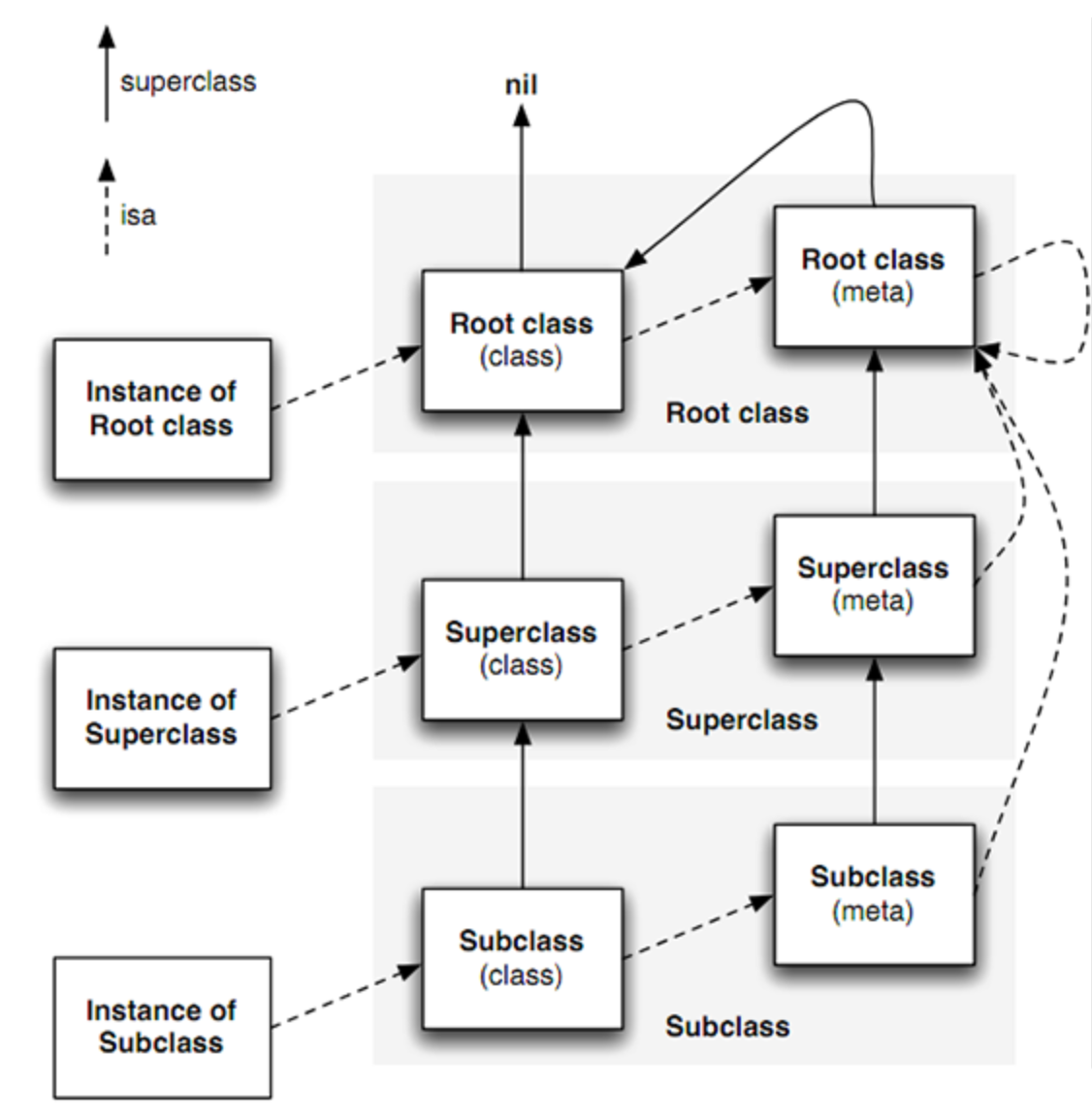
|
||
|
||
Quiz
|
||
|
||
```objectivec
|
||
NSLog(@"%hhd", [NSObject isKindOfClass:[NSObject class]]); // 1
|
||
NSLog(@"%hhd", [NSObject isMemberOfClass:[NSObject class]]); //0
|
||
NSLog(@"%hhd", [Person isKindOfClass:[Person class]]); // 0
|
||
NSLog(@"%hhd", [Person isMemberOfClass:[Person class]]); //0
|
||
```
|
||
|
||
## Runtime 刁钻题
|
||
|
||
```objectivec
|
||
@interface Person : NSObject
|
||
@property (nonatomic, strong) NSString *name;
|
||
- (void)sayHi;
|
||
@end
|
||
@implementation Person
|
||
- (void)sayHi{
|
||
NSLog(@"hi,my name is %@", self->_name); // hi,my name is 杭城小刘
|
||
}
|
||
@end
|
||
|
||
int main(int argc, const char * argv[]) {
|
||
@autoreleasepool {
|
||
NSString *temp = @"杭城小刘";
|
||
id obj = [Person class];
|
||
void *p = &obj;
|
||
[(__bridge id)p sayHi];
|
||
|
||
test();
|
||
}
|
||
return 0;
|
||
}
|
||
```
|
||
|
||
程序运行什么结果?
|
||
|
||
```
|
||
hi,my name is 杭城小刘
|
||
```
|
||
|
||
为什么会方法调用成功?为什么 name 打印出为 @"杭城小刘"
|
||
|
||
我们来分析下:
|
||
|
||
1.**方法调用本质就是寻找 isa 进行消息发送**
|
||
|
||
```objectivec
|
||
Person *person = [[Person alloc] init];
|
||
[person sayHi];
|
||
```
|
||
|
||
`[[Person alloc] init]`在内存中分配一块内存,然后 isa 指向这块内存,然后 person 指针,指向结构体,结构体的第一个成员。
|
||
|
||
2.**栈空间数据内存向下生长。第一个变量地址高,其次降低。且每个变量的内存地址是连续的。**
|
||
|
||
这个流程其实和上面的代码一样的。所以可以正常调用
|
||
|
||
```c
|
||
void test () {
|
||
long long a = 4; // 0x7ff7bfeff2d8
|
||
long long b = 5; // 0x7ff7bfeff2d0
|
||
long long c = 6; // 0x7ff7bfeff2c8
|
||
NSLog(@"%p %p %p", &a, &b, &c);
|
||
}
|
||
```
|
||
|
||
方法内的变量存储在栈上,堆向上增长,栈向下增长。
|
||
|
||

|
||
|
||
3.**实例对象的本质就是一个结构体,存储所有成员变量(isa 是一个特殊成员变量,其他的成员变量,这里就是 _name),`sayHi` 方法内部的 self 就是 obj,找成员变量的本质就是找内存地址的过程(此时就是偏移8个字节)**
|
||
|
||
上面代码可以类比类调用方法的流程。 obj 指针指向 Person 这块内存,给类对象发送 `sayHi` 消息也就是通过 obj 指针找到 isa,恰好 obj 指针指向的地址就是类对象的类结构体的地址,结构体成员变量第一个就是 isa 指针,结构体的其他成员变量就是类的其他属性,这里也就是 `_name`,所以我们给自定义的指针 `void *p` 调用 sayHi 方法,系统 runtime 在打印 name 的时候,会在 p 附近(下8个字节,因为 isa 是指针,长度为8)找 `_name` 属性,此时也就找到了 temp 字符串。
|
||
|
||
```c
|
||
struct Person_IMPL {
|
||
Class isa; // 8字节
|
||
NSString *_name; // 8字节
|
||
}
|
||
```
|
||
|
||
再看一个变体1
|
||
|
||
```c
|
||
NSObject *temp = [[NSObject alloc] init];
|
||
id obj = [Person class];
|
||
void *p = &obj;
|
||
[(__bridge id)p sayHi];
|
||
// hi,my name is <NSObject: 0x101129d60>
|
||
```
|
||
|
||
再看一个变体2(将代码放在 ViewController中)
|
||
|
||
```objectivec
|
||
- (void)viewDidLoad {
|
||
[super viewDidLoad];
|
||
id obj = [Person class];
|
||
void *p = &class;
|
||
NSObject *temp = [[NSObject alloc] init];
|
||
[(__bridge id)p sayHi];
|
||
}
|
||
// hi,my name is <ViewController: 0x7fe246204fd0>
|
||
```
|
||
|
||
搞懂的小伙伴不迷惑了。没搞懂其实就是没搞懂**栈地址由高到低,向下生长** 和 `super` 调用的本质。
|
||
|
||
再强调一句,根据指针寻找成员变量 _name 的过程其实就是根据内存偏移找对象的过程。在变体2中,isa 地址就是 class 的地址,所以按照`地址 +8` 的策略,其实前一个局部变量。
|
||
|
||
`[super viewDidLoad];` 本质就是 `objc_msgSendSuper({self, class_getSuperclass(self)}, sel_registerName("viewDidLoad"))`
|
||
|
||
```c
|
||
struct objc_super arg = {self, class_getSuperclass(self)};
|
||
objc_msgSendSuper(arg, sel_registerName("viewDidLoad"));
|
||
```
|
||
|
||
所以此时的“前一个局部变量” 也就是结构体 `objc_super` 类型的 arg。arg 是一个结构体,结构体第一个成员变量就是 self,所以“前一个局部变量” 也就是 self(ViewController)
|
||
|
||

|
||
|
||
## 应用场景
|
||
|
||
1.统计 App 中未响应的方法。给 NSObject 添加分类
|
||
|
||
```objectivec
|
||
- (NSMethodSignature *)methodSignatureForSelector:(SEL)aSelector
|
||
{
|
||
// 本来能调用的方法
|
||
if ([self respondsToSelector:aSelector]) {
|
||
return [super methodSignatureForSelector:aSelector];
|
||
}
|
||
// 找不到的方法
|
||
return [NSMethodSignature signatureWithObjCTypes:"v@:"];
|
||
}
|
||
|
||
// 找不到的方法,都会来到这里
|
||
- (void)forwardInvocation:(NSInvocation *)anInvocation
|
||
{
|
||
NSLog(@"找不到%@方法", NSStringFromSelector(anInvocation.selector));
|
||
}
|
||
@end
|
||
```
|
||
|
||
2.修改类的 isa
|
||
|
||
`object_setClass` 实现
|
||
|
||
```objectivec
|
||
Person *p = [Person new];
|
||
object_setClass(p, [Student class]);
|
||
```
|
||
|
||

|
||
|
||
3.动态创建类
|
||
|
||
`objc_allocateClassPair`、`objc_registerClassPair` 成对存在
|
||
|
||
动态创建类、添加属性、方法
|
||
|
||
```objectivec
|
||
void study (id self, SEL _cmd) {
|
||
NSLog(@"在学习了");
|
||
}
|
||
|
||
void createClass (void) {
|
||
Class newClass = objc_allocateClassPair([NSObject class], "GoodStudent", 0);
|
||
class_addIvar(newClass, "_score", 4, 1, "i");
|
||
class_addIvar(newClass, "_height", 4, 1, "i");
|
||
class_addMethod(newClass, @selector(study), (IMP)study, "v16@0:8");
|
||
objc_registerClassPair(newClass);
|
||
id student = [[newClass alloc] init];
|
||
[student setValue:@100 forKey:@"_score"];
|
||
[student setValue:@177 forKey:@"_height"];
|
||
[student performSelector:@selector(study)];
|
||
NSLog(@"%@ %@", [student valueForKey:@"_score"], [student valueForKey:@"_height"]);
|
||
}
|
||
```
|
||
|
||

|
||
|
||
runtime 中 copy、create 等出来的内存,不使用的时候需要手动释放`objc_disposeClassPair(newClass>)`
|
||
|
||
4.访问成员变量信息
|
||
|
||
```objectivec
|
||
void ivarInfo (void) {
|
||
Ivar nameIvar = class_getInstanceVariable([Person class], "_name");
|
||
NSLog(@"%s %s", ivar_getName(nameIvar), ivar_getTypeEncoding(nameIvar)); //_name @"NSString"
|
||
// 设置、获取成员变量
|
||
Person *p = [[Person alloc] init];
|
||
Ivar ageIvar = class_getInstanceVariable([Person class], "_age");
|
||
object_setIvar(p, ageIvar, (__bridge id)(void *)27);
|
||
NSLog(@"%d", p.age);
|
||
}
|
||
```
|
||
|
||
runtime 设置值 api `object_setIvar(id _Nullable obj, Ivar _Nonnull ivar, id _Nullable value)` 第三个参数要求为 id 类型,但是我们给 int 类型的属性设置值,怎么办?可以将27这个数字的地址传进去,同时需要类型转换为 id `(__bridge id)(void *)27)`
|
||
|
||
KVC 可以根据具体的值,去取出 NSNumber ,然后调用 intValue
|
||
|
||
`[p setValue:@27 forKey:@"_age"];`
|
||
|
||
5.访问对象的所有成员变量信息
|
||
|
||
```objectivec
|
||
@property (nonatomic, strong) NSString *name;
|
||
@property (nonatomic, assign) int age;
|
||
@end
|
||
|
||
unsigned int count;
|
||
// 数组指针
|
||
Ivar *properties = class_copyIvarList([Person class], &count);
|
||
for (int i =0 ; i<count; i++) {
|
||
Ivar property = properties[i];
|
||
NSLog(@"属性名称:%s, 属性类型:%s", ivar_getName(property), ivar_getTypeEncoding(property));
|
||
}
|
||
free(properties);
|
||
//属性名称:_age, 属性类型:i
|
||
// 属性名称:_name, 属性类型:@"NSString"
|
||
```
|
||
|
||
根据这个可以做很多事情,比如设置解模型、给 UITextField 设 placeholder 的颜色
|
||
|
||
先根据 `class_copyIvarList` 访问到 UITextFiled 有很多属性,然后找到可疑累`_placeholderLabel`,通过打印 class、superclass 得到类型为 UILabel。所以用 UILabel 对象设置 color 即可,要么通过 KVC 直接设置
|
||
|
||
```objectivec
|
||
[self.textFiled setValue:[UIColor redColor] forKeyPath:@"_placeholderLabel.textColor"];
|
||
```
|
||
|
||
或者设置字典转模型(不够健壮,随便写的。具体可以参考 YYModel)
|
||
|
||
```objectivec
|
||
+ (instancetype)lbp_modelWithDic:(NSDictionary *)dict
|
||
{
|
||
id obj = [[self alloc] init];
|
||
unsigned int count;
|
||
Ivar *properties = class_copyIvarList([self class], &count);
|
||
for (int i =0 ; i<count; i++) {
|
||
Ivar property = properties[i];
|
||
NSString *keyName = [[NSString stringWithUTF8String:ivar_getName(property)] stringByReplacingOccurrencesOfString:@"_" withString:@""];
|
||
id value = [dict objectForKey:keyName];
|
||
[self setValue:value forKey:keyName];
|
||
}
|
||
free(properties);
|
||
return obj;
|
||
}
|
||
```
|
||
|
||
6.替换方法实现
|
||
|
||
注意
|
||
|
||
- 类似 NSMutableArray 的时候,+load 方法进行方法替换的时候需要注意类簇的存在,比如 `__NSArrayM`
|
||
|
||
- 方法交换一般写在类的 `+load` 方法中,且为了防止出问题,比如别人手动调用 load,代码需要加 `dispatch_once`
|
||
|
||
```objectivec
|
||
void studentSayHi (void) {
|
||
NSLog(@"Student say hi");
|
||
}
|
||
void changeMethodImpl (void){
|
||
class_replaceMethod([Person class], @selector(sayHi), (IMP)studentSayHi, "v16@0:8");
|
||
Person *p = [[Person alloc] init];
|
||
[p sayHi];
|
||
}
|
||
// Student say hi
|
||
```
|
||
|
||
上述代码可以换一种写法
|
||
|
||
```objectivec
|
||
class_replaceMethod([Person class], @selector(sayHi), imp_implementationWithBlock(^{
|
||
NSLog(@"Student say hi");
|
||
}), "v16@0:8");
|
||
Person *p = [[Person alloc] init];
|
||
[p sayHi];
|
||
```
|
||
|
||
`imp_implementationWithBlock(id _Nonnull block)` 该方法将方法实现替换为包装好的 block
|
||
|
||
```objectivec
|
||
Person *p = [[Person alloc] init];
|
||
Method sleep = class_getInstanceMethod([Person class], @selector(sleep));
|
||
Method sayHi = class_getInstanceMethod([Person class], @selector(sayHi));
|
||
method_exchangeImplementations(sleep, sayHi);
|
||
[p sayHi]; // 人生无常,抓紧睡觉
|
||
[p sleep]; // Person sayHi
|
||
```
|
||
|
||
7.无痕埋点
|
||
|
||
对 App 内所有的按钮点击事件进行监听并上报。发现 UIButton 继承自 UIControl,所以添加分类,在 load 方法内,替换方法实现。UIControl 存在方法 `sendAction:to:forEvent:`
|
||
|
||
```objectivec
|
||
@implementation UIControl (Monitor)
|
||
+ (void)load {
|
||
Method method1 = class_getInstanceMethod(self, @selector(sendAction:to:forEvent:));
|
||
Method method2 = class_getInstanceMethod(self, @selector(lbp_sendAction:to:forEvent:));
|
||
method_exchangeImplementations(method1, method2);
|
||
}
|
||
- (void)lbp_sendAction:(SEL)action to:(id)target forEvent:(UIEvent *)event {
|
||
NSLog(@"%@-%@-%@", self, target, NSStringFromSelector(action));
|
||
// 调用系统原来的实现
|
||
[self mj_sendAction:action to:target forEvent:event];
|
||
// [target performSelector:action];
|
||
}
|
||
@end
|
||
```
|
||
|
||
为了对业务代码无影响,在 hook 代码内部又要调用回去,所以需要调用原来的方法,此时因为交换方法实现,所以原来的方法应该是 `lbp_sendAction:to:forEvent:`
|
||
|
||
`method_exchangeImplementations` 方法实现交换了,系统会清空缓存,调用 `flushCaches` 方法,内部调用 `cache_erase_nolock` 来清空方法缓存。
|
||
|
||
```c
|
||
void method_exchangeImplementations(Method m1, Method m2)
|
||
{
|
||
if (!m1 || !m2) return;
|
||
rwlock_writer_t lock(runtimeLock);
|
||
IMP m1_imp = m1->imp;
|
||
m1->imp = m2->imp;
|
||
m2->imp = m1_imp;
|
||
|
||
// RR/AWZ updates are slow because class is unknown
|
||
// Cache updates are slow because class is unknown
|
||
// fixme build list of classes whose Methods are known externally?
|
||
flushCaches(nil);
|
||
updateCustomRR_AWZ(nil, m1);
|
||
updateCustomRR_AWZ(nil, m2);
|
||
}
|
||
|
||
static void flushCaches(Class cls)
|
||
{
|
||
runtimeLock.assertWriting();
|
||
mutex_locker_t lock(cacheUpdateLock);
|
||
if (cls) {
|
||
foreach_realized_class_and_subclass(cls, ^(Class c){
|
||
cache_erase_nolock(c);
|
||
});
|
||
}
|
||
else {
|
||
foreach_realized_class_and_metaclass(^(Class c){
|
||
cache_erase_nolock(c);
|
||
});
|
||
}
|
||
}
|
||
```
|
||
|
||
总结:
|
||
|
||
OC 是一门动态性很强的编程语言,允许很多操作推迟到程序运行时决定。OC 动态性其实就是由 Runtime 来实现的,Runtime 是一套 c 语言 api,封装了很多动态性相关函数。平时写的 oc 代码,底层大多都是转换为 Runtime api 进行调用的。
|
||
|
||
- 关联对象
|
||
|
||
- 遍历类的所有成员变量(可以访问私有变量,比如修改 UITextFiled 的 placeholder 颜色、字典转模型、自动归档接档)
|
||
|
||
- 交换方法实现
|
||
|
||
- 扩大点击区域
|
||
|
||
- 利用消息转发机制,解决消息找不到的问题
|
||
|
||
- 无痕埋点
|
||
|
||
- 热修复
|